
9/1/26 8:51 pm Judy
Disclaimer:
It is well known that human memory is unreliable, especially after a long time. Furthermore, no two people will see or hear the same thing in any given situation.
This memoir is not intended to be the absolute truth of what happened a long time ago, but rather a picture of what I thought was happening at the time.
Although I have tried to limit my writing to events that I experienced firsthand, some events are secondhand, as told to me by eyewitnesses.
If you know any of this stuff to be inaccurate, please leave a comment.
H1
H2
H3
H4
Background
I am a 13th generation American born in Massachusetts. My interests are a combination of business, science, and art. I am a lifelong entrepreneur, and it was always my dream to design and make products. I have lived in many parts of the U.S.A. as well as England and Holland.
Moving around a lot influenced my development: I remember one incident that changed my life: When I was too young to go to school, I was playing in the backyard of our house somewhere
in IL, when my mother opened the back door and said, "Better come in now; we have to move again".
I immediately said to myself: "That does it! I'm never going to make friends with anyone again,
because as soon as I do, we have to move away and break my heart!
As it happened, it prevented me from getting close to people for the rest of my life. I like people, and
can get along with anybody, but I don't have close relationships with human beings. Small incidents
can have life-changing effects on small children
My career as a dilettante...
At age 12, I wanted to become a nuclear physicist and industrialist. In college, I majored in physics, but now I'm just a dabbler.
So from 1967 to 1970, I dabbled in making records. From 1968 to 1975, I dabbled in making equipment for recording studios, and in 1985, I started developing products for optical disc manufacturing.
I also like to think of myself as a sort of "Forrest Gump" character, just drifting through life whichever way the wind takes me. More of an observer than a participant.
Music
At about age 8, my parents took us to a Tchaikovsky concert at the Hollywood Bowl. It was a wonderful warm summer night with perfume in the air, and when they played "Waltz of the Flowers" I swear I felt something snap inside my head! The experience had an effect on me. I didn't know what it was at the time, but I think I wanted to capture the feeling I had that night. I got a record of "Nutcracker Suite" and wore it out!
I don't know where I heard about tape recording, but from that time forward, I wanted a tape recorder more than anything else. I'd never even seen one, except in the Sears Roebuck catalog, but somehow I felt that it could capture feelings like that night at the Hollywood Bowl. I wanted to "capture lightning in a bottle". I also wanted to build a dream recorder. Wouldn't that be fun?
Around age 9, I took up the violin. I loved the sound of it; so expressive! I did OK for a while, and even played first chair in a community orchestra for kids. But by the time I was 12, other 12 year-olds got better, and I didn't. Should have practiced more! Anyway, at age 16, I took up the alto saxophone. By now, I was mainly listening to Jazz. A few of the saxophone players I admired were Paul Desmond, Johnny Hodges, and Hank Crawford.
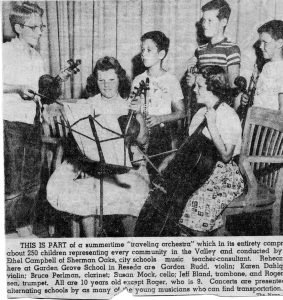
My Violin Career…
My Life Changes...
In 1962, while driving home from high school, “Green Onions” by Booker T. and the M.G.s came on the radio. It got me right away, and I remember saying to myself, “That’s what a record ought to sound like!” Besides the fact that the music was way cool, it was also the sound and the arrangement. It was so clear and open and punchy. No ambiguity or confusion. Ever since then, Booker T. & the M.G.s has been my favorite band! Little did I realize that 5 years later I would be recording Booker T. & the M.G.s at STAX Records in Memphis!
Chapter One
Skyhill Drive

Skyhill Drive
Leon wanted someone he could train himself, because he didn’t like the way regular studios operated.
This was about 1966, and the '60s were a transitional period in the music industry. Not only was the music changing, but the way records were made was changing too, and much of it was experimental. Leon was somewhat of a pioneer in record production, like Phil Spector or Brian Wilson.
Leon Russell
So I was fortunate to learn how to make records from Leon. He was an amazingly talented guy.
The first meeting was very different than what I expected. I was told that Leon had a recording studio in his house, but I didn’t expect a full-blown professional setup. That was very rare in those days. It was not fancy but it was as good as most any serious studio in Hollywood at that time.
The entire ground level was taken over by the studio. The decor in the house was “early hippy”. Bare linoleum floors with no rugs, various walls spray painted black or neon green. Nothing was ever finished: Walls we typically partly painted or otherwise unfinished. There was a Stienway grand piano and a couch in the living room, and nothing else. Leon’s bedroom had a bed and a dresser. I don’t remember any other furniture. But it was perfect for the intended purpose. It was clear that Leon was serious about what he was doing.
I think I got the job because of my expeerience at the radio station, the fact that I knew who Jim Keltner and Korla Pandit were, plus I had some of Leons obscure records that he produced.
At that time, Leon's hair was shoulder length, and he had the beginnings of a mustache and beard. He typically wore blue jeans, cowboy boots, and a western style shirt with snaps instead of buttons.
Leon had a peculiar walk and pose. He held his right arm like it was in a sling. At first, I thought is was an affectation, but he later told me that he had polio as a child, and his right side was partially paralyzed.
At that time, he drove a big, black Cadillac with a phone, so he wouldn't miss a call for a recording session.
I also blown away by the sound in the control room. I’d never heard anything like that. It not only sounded like “live,” but better! The room was fairly small, probably 10’ x 12’. Mixing position was probably only 5’ from the speakers, and in those days, we listened really loud just ‘cause it sounded so good.
Leon was very nice, and treated me very well. He took me to Capitol Records and RCA studios to witness recording sessions with people like Sonny & Cher, and Wayne Newton. We also used to eat at a sidewalk hamburger stand on Vine Street, directly across from the Capitol Records building.
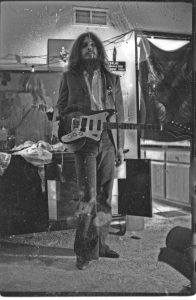
Leon in his bedroom
Leon was not only a great piano player, but also a great bandleader and arranger. He was the arranger and conductor on the Wayne Newton session, with a live 40 piece orchestra. Leon rehearsed the orchestra briefly while waiting for Wayne to appear. While running down one song, Leon stops and says, "Third violin—at bar 79 that's a b-flat." It blew my mind that he could hear that, although I suppose any good orchestra conductor could do that. To me, it was magic!
Leon told me that he had a "photographic" memory for sound. He claimed he remembered every sound he heard, and if you slammed a car door, he could tell you what key it was in. I don’t know if that's true, but he certainly had an ear for music.
There was a constant stream of musicians coming and going, all interesting, talented people, so I was having fun. Leon was a member of the legendary group of Hollywood studio musicians that was known as “The Wrecking Crew.” These were some of the best musicians in the country, and probably the world. They were in demand for recording sessions because they could play anything at sight in one take without mistakes, and therefore minimize the expense of the recording session. In those days, it took big money to make a record. Now, anyone can make a record in their bedroom with an Apple laptop.
Leon once told me that for a gag, he wrote a guitar part that was physically impossible to play. But Tommy Tedesco played it at sight in one take without blinking!
The Skyhill “house band” I remember at the time was Leon Russell, Ed Davis, Bill Boatman, Chuck Blackwell, John Gallie, and Carl Radle. I really enjoyed working with that band.
I was a full-time physics student in my senior year at UCLA at the time. The schedule at Skyhill started at 1PM, and continued until maybe 1AM. I don’t remember how many days a week I worked, but I remember I made $75 a week.
After a while, Leon invited me to come live at Skyhill. I accepted, and moved in. I got the biggest bedroom (except for Leon’s), and poor Mark Benno had to live in a closet! I still feel bad about that…
After I moved in, I just quit going to school. I didn’t notify the school or anything; I just quit showing up. By now, it was clear that I wasn’t going to make a living as a physicist. I was more interested in practical applications. I studied physics only because I wanted to know what the laws of nature are. I figured that if I just knew the laws of nature, everything else would follow.
In retrospect, I guess that plan more or less worked out. My father was an inventor, and that’s what I wanted to be. I also discovered, starting with the UCLA radio station, that the vast majority of people in the music and audio business didn’t know anything about physics (sound, acoustics, electronics, etc.)! So that gave me a big advantage over most others.
One of my first projects was the Delaney & Bonnie “Home” album. I remember that one well, especially “Piece of My Heart.” My recollection is that Bonnie sang it live in the living room, so she was somewhat isolated from the band in the studio. I just remember that it was a moving experience!
It was the Delaney & Bonnie record that allowed me to work with Steve Cropper and Duck Dunn. It worked out pretty well for the band too, as their next album caught the attention of the likes of Eric Clapton and George Harrison.
I also remember Lenny Waronker, who asked me every 5 minutes, “Is this any good?” I was shocked that the president of Warner Bros. Records was asking me if it was “any good.”
Leon and I got along really well. Leon was very kind to me, and at one time, we were like best friends, or at least as close to "best friends" as I can get. But I do have to explain that at that time, I was very shy and had no social skills whatsoever (and still don’t). I like people, and can get along with just about anybody, but I don’t have relationships. I don’t “hang out” or socialize in any way. I have an idea that Leon suffered a bit from the same affliction.
I also really liked the guys in the band. I thought they were all really nice people. I especially liked Carl Radle and John Gallie.
Most of the band and artists were friends of Leon's from Tulsa. I remember seeing a letter he sent to his buddies in Tulsa, saying, "You all should come out to California, and we can make records".
I don’t recall having any serious discussions with Leon about anything. I was in awe of musicians with his level of talent, which was all a mystery to me. We once had a deal where Leon would teach me music, and I would teach him electronics. Didn’t last long, though.
Leon worked the band really hard. In my opinion, he was a great bandleader. I always thought he should have taken advantage of that more. I remember ending sessions where the band could barely walk to the door; they were so tired, and hearing someone say, “Gee, I didn’t know I could do that!”
I also remember that he had an almost telepathic connection with the band and crew. He could just look at you, and suddenly you would know what to do.
Leon was not into drugs or partying at all as far as I knew. He didn’t smoke or drink in my presence. The only drug I ever saw him do was marijuana, and not much at that. He drank a lot of water. I stayed out of his personal life. I just tried to do my job and keep my mouth shut. I've always considered that to be a secret to success.
I was introduced to marijuana at Skyhill. I had never smoked or tasted alchohal until I was 21 years old.
If you are interested in the kinds of studio gear used in a 1960's state of the art recording studio, click here.
Donna Washburn
Donna Washburn was Leon's girlfriend at the time. I assume he met her through his work with Gary Lewis & the Playboys, as she had been engaged to Gary Lewis. When I first met Donna, I was stunned. She was beautiful and flashy, like you would imagine a movie star. Quite stunning. I did get to know her pretty well, and really, she wasn’t what I imagined at first. She was very nice and actually pretty conservative.
Donna was from San Marino, a wealthy suburb north of LA. Her home there was a mansion I would describe as just like the one on the "Beverly Hillbillies" TV show. Her father owned the 7Up bottling company of Los Angeles and died young.
I saw an article in the LA Times about how Donna's mother owned the two most expensive houses in California: the San Marino house and one in Newport Beach. Donna went on to have a successful career in music as a backup singer with Leonard Cohen, Mad Dogs & Englishmen, Dillard & Clark, Jennifer Warnes, and others. The perfect fantasy: young, beautiful, talented, and rich!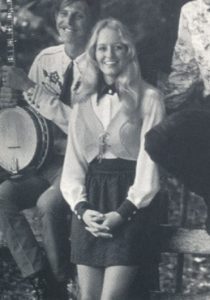
After a while, Leon and Donna were engaged to be married. Leon moved in with Donna in her house on Woodrow Wilson Dr. in Hollywood. I recorded some of Leon's improvised piano pieces in Donna's living room that I felt could have been a record. Wish I still had that tape...
One day, while sitting on the couch in Donna’s living room, I noticed a stack of sheet music next to me on the couch. I started looking through it and saw that it was all old 19th century popular tunes. I was curious about what he was doing with this stuff: was he looking for song ideas? It looked like all the sheet music was probably in the public domain, due to its age. Never did find out.
Rita Coolidge
I can brag that I lived with Rita Coolidge, ha ha! We both lived at Skyhill at the same time for a while. I don’t think I ever said much to her the whole time. I was very shy, and it seemed like she was too.
Laurel Hunter
Laurel was the proverbial "girl next door". She was living with her parents across the street from Leon's house on Skyhill Dr.
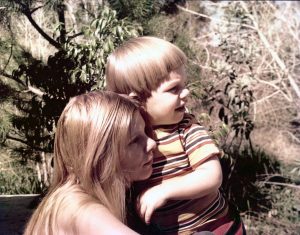
Laurel & Chris
It seems that she was walking home one day, when Chuck Blackwell, who was on his way to a session at Skyhill, spotted her and gave her a ride. He introduced me to Laurel, then went to "work" in the studio. Chuck had a reputation as a "ladies man", was a rock & roll drummer, and he looked just like Robert Redford!
My recollection is that she was 19 years old. She was quite wild and adventurous, and I was not. We were "The Owl and the Pussycat". I have no idea what she saw in me, but she was hot! So we were soon lovers. We lived together for 7 years, and although we never married, I now refer to her as "my first wife". This was my first experience living with a girl.
We eventually moved into an apartment in North Hollywood and then moved to Memphis, where our son Chris was born. Laurel taught me a lot about life.
Charlie Manson
When I met Laurel, her parents had recently moved to Skyhill Drive from Cielo Drive in Beverly Hills. Laurel told me that they lived next door to the house where Sharon Tate, Jay Sebring, and Abigail Folger were murdered by Tex Watson and Manson's Girls. She said that she knew the pool boy who found the bodies the next morning.
The day after Charlie and the girls were arrested at the Spahn Ranch in Chatsworth, Laurel and a friend went out to the Spahn Ranch to look around. She brought back this book that I still have. It seems that Charlie had quite a stash of philosophy books that he would read and then re-regurgitate to the girls, who then thought he was a genius. Too bad he didn't write his name in it; it might be worth something!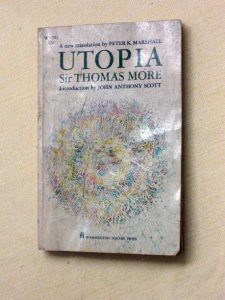
It wasn't well known at the time, but what was really going on was that Charlie wanted to murder Terry Melcher, who was Doris Day's son.
Manson was an aspiring singer/songwriter and had auditioned for Terry, who was an A&R man at Columbia Records. Terry turned him down, which apparently pissed Charlie off. He wrote an address down on a piece of paper, and gave it to Tex Watson, telling him, "Go to this address and kill everyone there". Unbeknownst to Charlie, Terry was in Europe, and had rented the house out to Roman Polanski and his girlfriend Sharon Tate.
The five unluckiest people in the world!
Well, I certainly learned a lot! Leon taught me everything I know. One thing I learned was that there were few people who knew anything about making records. Learning from Leon was a blessing.
Having learned record production from Leon, I suddenly became a “genius.” Leon was so respected by those in the music business that they figured I must be a genius too. Unfortunately, I didn’t realize this at the time and didn’t take advantage.
There was always a steady stream of people coming to Skyhill from all over the world to meet Leon. Although he was not yet a household name, he was well known among musicians.
Some of the people I met or worked with at Skyhill: I wish I was writing the biographies of these guys because their lives were much more interesting than mine.
Mark Benno
Chuck Blackwell
Bonnie & Delaney Bramlett
J.J. Cale
Rita Coolidge
Steve Cropper
Ed Davis
Duck Dunn
John Gallie
Jim Gordon
Jim Horn
Plas Johnson
Jimmy Karstein
Jim Keltner
Bobby Keys
Sandy Konikoff
Taj Mahal
Jimmy Markham
Buddy Miles
Don Nix
Don Preston
Carl Radle
Gordon Shryock
Dean Stockwell
Lenny Waronker
Jerry Allison was the drummer with Buddy Holly and the Crickets. At Skyhill, he showed me a letter Buddy Holly got from John Lennon back in the day. I saw it with my own eyes. John wrote, “We here in Liverpool are big fans of the Crickets. I have a band too. We call ourselves The Beatles, after the Crickets”.
Gary Busey—Leon took Gary & I to see “All the President’s Men’ at the Cinerama Dome. Leon told me that Gary had a "cooking show" on Community Access TV in Tulsa that Leon saw and called Gary up. Gary became a drummer in Leon's band, although I don't know what they did together. If you know, leave a comment.
Asylum Choir
Most of the time was spent on the "Asylum Choir" album, Leon's first record as an artist. I got the feeling that Leon felt that as a session musician and arranger, he was doing all the heavy lifting, and the "artist" with his name on the record was getting all the money and credit. So I think Leon wanted to become the "artist". Leon had a bad case of "stage fright, though and described to me how awful it was standing on a stage in front of 50,000 people.
He was also very private. He never told anyone what he was trying to do, or let anyone see the Real Leon. He wanted to be a mysterious figure like Bob Dylan or Korla Pandit. I wish I had recorded some of the "real Leon" at the time. I think that he thought that the real leon was too boring, and he had to put on some kind of act in order to be accepted.
We did make some 16mm movies, but I don't know what happened to them.
He was terrible at interviews too. I know the feeling: If I open up and tell all, I'll sound like an ideot. and ruin the whole show. It's easier to put on the clown suit and stay away from the public.
I recall spending a lot of time, as Leon played all the instruments himself and involved a lot of overdubbing. I thought the music was pretty weird, considering what I knew he could do. I guess Leon & Marc had a concept, but I never really knew what it was. The one song on the album I really liked was “Death of the Flowers,” a Greg Dempsy composition.
At that time, The Beatles were a big influence. It was a contest to see who could be more psychedelic and more unique. The fact that the Beatles were English was a big advantage for them: The Beatles were just doing Rock & Roll and R&B but were just different enough to make them interesting.
While working on the Delaney & Bonnie "Home" album, I had the pleasure of working with my idols Steve Cropper and Duck Dunn. Steve seemed to like the way I worked, and said that if I came to Memphis, I might be able to get a job at STAX.
After the Asylum Choir record was released, we continued working on songs for the second album. The first record got some airplay and attention, but it was too much like pulling teeth. Everything took so long that I got tired of it, so I decided to move to Memphis.
Arriving in Memphis in the middle of the night, I opened the door to exit the airport terminal, and I immediately thought I accidentally opened the door at the bottom of the ocean! I had never experienced humidity like that! I immediately got sick, as moving from a dry climate to a humid one, often makes me sick. It happened in Singapore as well.
Anyway, Don Nix was kind enough to let me stay in his apartment and took care of me while I was bedridden for a week! Later, I moved in with Duck Dunn, his wife June, and kids. Duck even let me use his Corvette! After recovering, it seemed that there wasn’t much for me to do. So Cropper got me a job at Chess Records in Chicago.
Chapter 2 Chess Records
Chess Records was a legendary blues record label, with artists such as Chuck Berry, Muddy Waters, Howlin' Wolf, Etta James, Bo Diddley, and Little Walter.
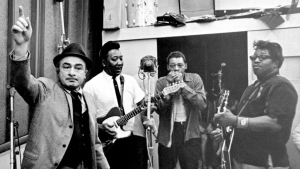
Leonard Chess, Muddy Waters, Little Walter, Bo Diddly
When the Rolling Stones first came to America, the first place they went was to Chess, as they were big fans.
While there, I worked with Etta James,, Willie Dixon, Shakey Horton, John Lee Hooker, Phil Upchurch, and many others.
Chess was a pretty big operation. It was interesting because they had an extensive library of authentic Chicago Blues from the 1940s and 1950s. Some of that stuff was positively electrifying; listening to those old tapes made my hair stand on end! It sounded like they were recorded in somebody's bedroom, and you could hear people talking, chairs being knocked over, and bottles breaking in the background. Fender reverb amps with reverb and tremolo turned up to #10!
I think my favorite was Little Walter. Leon once told me that if I could play the saxophone like Little Walter played the harmonica, I could make millions! I got a record and gave it a try, but I'll be damned if I could figure out what he was doing!
Anyway, Marshall Chess (son of co-founder Leonard Chess and founder of Rolling Stones Records) told me about how they got started*: The Chess brothers had a nightclub in south Chicago (a tough neighborhood), where they hired bands to entertain. Marshall told me that Leonard had scars up and down both arms from taking knives away from patrons.When the gunfire started, he would throw Marshall behind the bar!
At some point, the brothers decided that they could make some money by recording the bands they were hiring. So they called up the local Ampex dealer and bought a tape recorder.
Since they had no experience, they had the guy from Ampex come out and show them how to work the recorder. According to Marshall, the brothers misunderstood the instructions about the VU meter, and thought that the needle was supposed to stay in the red!
Tape saturation is very different than clipping. The iron oxide saturates gradually, which produces a less objectionable distortion than outright clipping. My recollection is that the standard was that 0 VU corresponded to 3% harmonic distortion. Anyway, apparently much of the early stuff was recorded with the VU meter pegged. It turns out that worked well for the extremely raw, harsh music they were recording and became part of their signature sound.
* I can't swear that this is true, but it's what Marshall Chess himself told me firsthand. And I guess he should know.
Chess was a pretty big operation. Probably many times the size of STAX. It was interesting because they had an extensive library of authentic Chicago Blues from the '40s. Some of that stuff was positively electrifying.
I did have the opportunity to sit in on some of the "Fathers & Sons" Muddy Waters album, which was conceived as a handing down of the Blues Power to the new generation of young blues players.
My friend Duck Dunn played on it, and I recall that he was disappointed in the result, although I don't remember why.
I had a clock radio that woke me up to the news each morning. Every day, there were stories about a 12 year old gunning down a 13 year old on the street! It was a pretty tough town! The gangs used minors to do their killing, because they knew they would not get a long sentence if caught. Two of the gangs I remember were the "Cobra Stones" and "African Snipers Gangsters Den". I thought "Cobra Stones" was a cool name; kind of poetic. But "African Snipers Gangsters Den" was a little too scary.
Buddy Guy & Junior Wells
Besides Marshall, one of my few friends at Chess was Tom Swan. He was a harmonica player from Boston who hung around Chess trying to become a record producer. I never did figure out if he worked there or just hung around. He had black curly hair, a 1940s-style pencil-thin mustache, and one set of clothes. It was a black suit with a purple lining in the jacket. I never saw him wear anything else. He could fit right into a Blues Brothers movie.
One night, Tom Swan invited me to go with him to see Buddy Guy and Junior Wells play at a local south side nightclub. I don't remember which club it was, but it might have been "The Blue Flame". When we walked in, all the patrons turned and stared. We were the only white faces in the place (and probably for miles). I'll never forget the look on their faces: "Uh-oh... Here comes Trouble!" Everyone in the audience was terrified.
At the first break, Tom introduced us to Buddy & Junior. Junior got right up in my face (luckily, I was taller), and said, "I don't like you!" Those were his exact words. I was completely flustered, having never experienced anything like that before. I didn't have any idea what to do, so I just said, "Well, I'm not such a bad guy once you get to know me". That changed everything. Suddenly everything became normal. It seems that everyone thought that we came there to start a fight. I imagine that many of them were going for their guns. When they saw that we weren't going to start a fight, they were greatly relieved. I guess Junior figured that if we're going to fight, we might as well get started.
One of my favorite things about Chess was their tape library. They had tapes going back to the '40s of authentic Chicago Blues. Tragically, they were all recorded on acetate tape, which is all that was available in those days. Acetate tape disintegrates with age, so many, if not most, of the tapes were unplayable. One of my jobs was trying to salvage them. I'd end up with a 10" reel of tape with splices every six inches. A lot of that stuff is lost forever. I don't know if anyone ever solved that problem.
That music from the old days was the most intense music I ever heard. Most of the stuff sounded like it was recorded in somebody's bedroom, with sounds of chairs falling over, bottles breaking, and people talking. Some of those recordings would make your hair stand on end!! Reverb and tremolo turned up to 10.
My favorite was Little Walter. Leon once told me, "If you can learn to play saxophone like Little Walter plays harmonica, you can make millions!" So I got a Little Walter record and tried to copy what he was doing. I didn't have a turntable with variable speed, and for the life of me, I could not figure out what he was playing!!
Another job I had was to audition tapes and records that people sent in wanting to get a record deal. Of course they were awful, but there was one I recall: It was called "Switchblade Blues" and was recorded in one of those "telephone" booths that you put quarters in, and it makes a record. Just like the ones that take 4 photos for a quarter. I remember it because it was so primitive and raw and honest. I could just picture some South Chicago teenager singing & playing his heart out. Meanwhile, in Hollywood, there was no emotion in music at all...
Rev. Jesse Jackson
He had a bunch of activities to raise money for his cause, and one of them was the "Operation Breadbasket Choir". It was memorable because it was the largest live session I ever recorded: a 40-piece orchestra and an 80-piece choir! The studios at Chess were very large, as they were built when everything was live; no such thing as overdubbing, etc. I don't remember how many microphones I used, but the mixing board in Studio B had only 8 inputs. and it went straight to 4-track tape: Orchestra Left & Right, and Choir Left & Right.
Phil Upchurch
was the bass player for the Chess house band and played on many of their records. The thing I remember about him was that he would show up to work with an 8-foot snake around his neck! It was just part of his everyday outfit. Interestingly, the snake was very well behaved, and was no trouble. The loud music didn't bother it a bit. I don't recall anyone ever saying anything about it.
Biographies: If you are not familiar with some of these characters, you can learn about them here:
Some of the people I met or worked with at Chess Records:
Etta James,, Willie Dixon, Shakey Horton, John Lee Hooker, Phil Upchurch, Rev. Jesse Jackson, Buddy Guy, Junior Wells, and many others.
=================
Chapter 3 - Stax Records
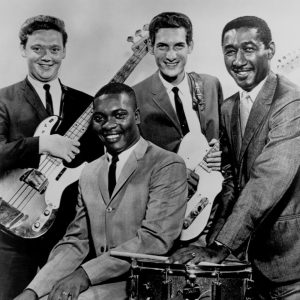
Booker T. & the M.G.s
I came to STAX in hope of working with Booker T. & The M.G.s.
At STAX, most of the acts were produced by either Steve Cropper, or Isaac Hayes.
Steve Cropper
Steve Cropper was a really talented guy. He was also very well organized. He always came prepared and knew exactly what he wanted to accomplish.
That enabled him to become the most prolific and best record producer in the country.
Isaac Hayes
I worked on quite a few records where Isaac was the producer/arranger/composer/sideman. Isaac was a really talented guy.
Ron Capone told me that when Isaac first started hanging around STAX, he worked in a slaughterhouse! He didn't have a pair of shoes until his girlfriend's parents bought him a pair for high school graduation.
I was there shortly after "Hot Buttered Soul" was a hit, so Isaac was a star. He always dressed nice, as befitting a star. I don't think I ever saw him wear the same thing twice. Except for his Mink Boots, which were very cool. He was easy to get along with and had a great voice.
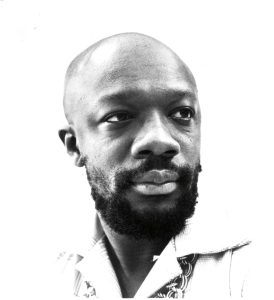
Isaac Hayes
I enjoyed the sessions with Billy Ekstine, who is not so well known today , but was a big star in the big-band era. Plus, he had an incredible voice.
I didn't work on any sessions with Isaac as the artist. At the time I was there, we were making the "Shaft" soundtrack. His sessions were all night affairs, and I remember the wreckage the next day: empty bottles, broken mic stands & chairs. I missed all the action!
Some of the artists I worked with:
Booker T & The M.G.s, Isaac Hayes, The Staple Singers, Mavis Staples, Rufus Thomas, The BarKays, Black Oak Arkansas, Billy Eckstine, Billy Eckstine, Luther Ingram, Mitch Ryder, Marvel Thomas, Rufus Thomas, Carla Thomas, and others.
Booker T. Jones
Most of the people at STAX were poor southerners, who were self-taught.
As far as I know, Booker was the only one at STAX who had a formal education in music. He told me he had a degree in music from Indiana University. He was a great musician & composer. There was no-one like him. He was very quiet and calm. He seemed like a real intelectual.
Rufus Thomas
- The only records I worked on at STAX that became a #1 hit, were "Funky Chicken" by Rufus Thomas, and "I Don't Wanna Be Right" by Luther Ingram. Rufus was known for his novelty records like "Walking the Dog", and "Funky Chicken" was the latest. You never can tell... But Rufus was actually quite talented and creative. He made some very good records. But he is mainly remembered for his novelty records.
Luther was a KoKo Records artist. KoKo was a New York record label headed by Johnny Baylor. and Luther’s record was produced by Johnny Baylor. When Johnny first came to STAX, the rumor was that KoKo was a Mafia record label, and Johnny was a former prizefighter and Mafia hitman. So I like to tell people that I worked with a "mafia hit man." Luckily, we got along fine...
Bobby Manual, who was also an engineer at STAX while I was there, also had an embarrassing success: he produced a record called "Disco Duck" that was a big hit. It was not a STAX record; he made it as an independent producer. After it became a big hit, he feared he would never live it down! You never can tell...
Tom Dowd
The STAX studio was a former movie theater. So it had a sloped floor. The control room was where the stage was behind the movie screen. Originally, the control room monitor speaker (mono) was an Altec "Voice of the Theater", which was the original movie theater speaker.
Ron Capone
Ron Capone was the chief engineer at STAX. Originally, it was Ron Capone, Jim Stewart, and Steve Cropper who did all the recording and mixing.
When I was there, the engineering staff consisted of Steve Cropper, Ron Capone, Bobby Manual, and myself.
They all learned recording from Tom Dowd of Atlantic Records, who distributed the STAX label.
Tom had a formula that the STAX people adhered to. I don't remember the specifics, but it was basically something like: Drums on the left, guitar or piano on the right, bass and vocal in the center. Everything was recorded in mono (one track) and panned left or right in the stereo mix.
Ron Capone told me that the Green Onions record was a jam that took place while waiting for the artist they were supposed to be recording. Jim Stewart heard it and turned on the tape machine. He said that the original lasted about 30 minutes, but Jim edited it down to 3 minutes, and released it as a B side.
Al Jackson Jr.
One of the Booker T. albums I recorded was "McLemore Avenue", which was an MGs version of "Abbey Road".
When I first landed in Memphis, as far as I could see, I was the only guy in Memphis to record in stereo. They had 16 track recording, but everything was just one track panned between L and R. They never used two mics from different positions. Al Jackson Jr. was the drummer, and I recorded him in stereo and also tuned his drums.
Anyway, when it was over, Al told me that I got the best drum sound he ever heard! As a big fan of the M.G.s, that was a high point of my recording career!
Tragically, Al was later murdered by the Mafia. The internet tells it a little differently, but this is how Cropper told it to me: Al had worked on a record produced by a Mafia-owned record company and didn't get paid the $100,000 he was owed. He told the producers that if he didn't get his money, he would go to the police. In the next scene, he is found in his home tied to a chair and shot in the head. Very tragic; he was a great drurmmer! I think I told you that I worked on a Luther Ingram record that was produced by a Mafia record label. I didn't have any trouble, though...!
"We Three"
Homer Banks, Raymond Jackson, and Betty Crutcher were songwriters at STAX who penned many of their biggest hits. They got together as a team and dubbed themselves "We Three".
Homer could only wear bedroom slippers because he never had a pair of shoes when he was young. He accepted a GRAMMY award in a tuxedo and bedroom slippers.
Raymond Jackson was a pretty low-key guy and guitar player. He also met a tragic death: he was plagued with gophers in his yard at home. If you've ever had gophers, you know how infuriating they can be. After numerous attempts to get rid of them, he poured gasoline down the hole and lit a match. The flames had nowhere to go but up and out of the hole, and Raymond was fatally injured.
Sandy Kay
Sandy was a keyboard and organ player who hung out at STAX. He would get occasional gigs, including filling in for Booker T. on some live performances.
Sandy was a little guy and a little wild. He used to carry a revolver in his waistband at work. One day at STAX, some of the crew took it away from him, which was a good thing, as someone could have gotten hurt.
The last time I talked to him, he gave me a video of him shooting a Thompson submachine gun. He claimed he had changed his name and was in the federal witness protection program.
Phil Ramone
Sandy and I took a road trip to New Jersey, to visit Sandy's family. On the way, we stopped to visit Phil Ramone's studio in New York. He was a big-time recording engineer specializing in jazz, and I was hoping I could get him interested in my digital recording idea.
Unfortunately, Sandy was a little scary looking, and with a pistol in his belt, Phil probably thought we were going to rob him! So Phil was rather uncomfortable and not too anxious to hear about digital recording.
After the passing of his wife, Rebecca, I have never seen anyone so broken up by her death. Sandy spent hundreds of hours making an elaborate wooden urn for her ashes. It was really quite touching...
Tina Turner
Sandy moved to LA about the same time as I and was playing in Ike & Tina Turner's band.
He invited me to Ike & Tina's house in Baldwin Hills, where Ike had a small studio. When I got there, I rang the bell, and Tina opened the door.
I was shocked to see that she had practically no hair, and what there was was white!
Black Oak Arkansas
One of the STAX artists I worked with was "Black Oak Arkansas". They were pretty amusing too: none of them had any front teeth! They told me that they
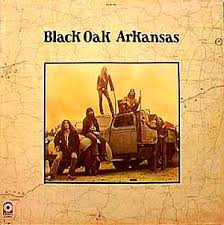
Black Oak Arkansas
got them knocked out by pool cues during barroom brawls in New Orleans. Once in a while, for a gag, they would remove their false teeth and grin into the camera. Five hillbillies with no front teeth!
I had forgotten all about it until one day a week ago, when a video about the band appeared in my YouTube feed. So out of curiosity, I watched it. Now I get hundreds of videos about the band in my YouTube feed! I didn't realize how popular they were!
I didn't get any credit because I left STAX to return to California after recording just a couple of songs. At that time (~1970), everybody was leaving Memphis for California. Rock & Roll was now where the money was, and a small R&B / Soul record label couldn't compete. So STAX and many other small record companies decided that they needed to get into the Rock & Roll business.
When the band was first signed to STAX, they were called "Knowbody Else". They did release one album, but I didn't have anything to do with that album, and I don't know how well it did. So they changed their name to "Black Oak Arkansas" (the name of the town in Arkansas they were from) and started a new album with me.
Their music wasn't really my cup of tea, but I did admire their intensity and stamina. They could jam for days without a break! And some of their songs were pretty good. They were genuine hillbillies!! The first time I ever saw anything like that.
When I returned to California, it turned out that the band arrived in L.A. at the same time. I met Jim Mangrum at the DMV, as we both needed new license plates for our cars. I never hung out with them before, but they invited me to their house in Chatsworth. When I got there, the place was littered with spoons, candles, syringes, and white powder. At that point, I decided that I didn't want to get involved with that, so that was the last I ever saw of them.
Apparently they left STAX too, as the record came out on ATCO, not STAX.
Several years later, I mentioned the band to my friend George Mihalakis. He told me that they were the biggest concert draw in the U.S.! I had no idea and didn't think about it again until seeing them on YouTube, playing to audiences of 300,000 in the early 1970s. Another "Forrest Gump" moment!
At STAX, I worked with
Booker T & The M.G.s, Isaac Hayes, The Staple Singers, Mavis Staples, Rufus Thomas, The BarKays, Black Oak Arkansas, Billy Eckstine, Billy Eckstine, Luther Ingram, Mitch Ryder, Marvel Thomas, Rufus Thomas, Carla Thomas, and many others, but to my disappointment, I never got to record Albert King.
ELVIS
Elvis's story is very different. He was very friendly and calm.
I lived just a mile or so from Elvis's home in Graceland. If you've never lived in the South, you need to know that "Southern hospitality" is a real thing. People are so friendly and treat you like family. Very different from LA or NY!
This was about 1968. In those days, Elvis would open the gates each Sunday and allow the public to come in and hang out. One day, Laurel & I did so. The way I remember it, there were fewer than a dozen people there. Today, it's like Disneyland! You couldn't go in the house, but you could wander the grounds. After a few minutes, Elvis came out the front door and greeted the people. I was shocked to see that he had a cast on his leg, from knee to ankle, and walked with a cane.
I asked him what happened to his leg, and he replied that he fell off his horse and broke his leg. I had no idea he had a horse or knew how to ride. Or maybe he didn't know how to ride, ha ha.
Anyway, Elvis was a very generous person. He did have an entourage and bodyguards when out in public, but it was all very casual. He didn't socialize outside his group of "homeboys." Southerners are extremely loyal and suspicious of outsiders.
===== Chapter 4 ====
Return to Hollywood...
The music at STAX was fantastic. It was all about the feel. There were never any charts; pretty much everything was made up on the spot.
The number one criterion was "the feel.” We used to joke that if a record didn’t have at least three mistakes, we wouldn’t release it.
I returned to California because there wasn't much opportunity to do the things I wanted to do, like build recording consoles, digital tape recorders, etc.
Shortly before I left Memphis, Ron Capone (chief engineer at STAX) brought some literature back from an AES convention in New York. I spotted this sheet from "Creatronics," an outfit in LA that made a rather futuristic looking multi-track tape recorder. So when I got to LA, I called them up and talked to Keith Olson, the leader of the outfit, thinking they might be interested in my digital tape recorder idea.
It turned out they never made the tape recorder, but I thought they had some good ideas.
Since 1968, my goal has been to make a digital tape recorder. I perceived that the two weakest links in the audio chain were the loudspeaker and the tape recorder. It occurred to me that if the sound was digitized and recorded in digital format, many of the tape recorder’s shortcomings would disappear. No tape noise or , unlimited dynamic range, and lossless copying were a few. Furthermore, in digital form, it could be manipulated by a computer, opening up a whole new world of effects.
========
Sound City
Things were very different in LA. After working with The M.G.'s and Isaac Hayes, the music in Hollywood seemed really soulless.
Everyone was concerned with everything being in tune and technically perfect. Just the opposite of Memphis.
Although there were digital tape recorders, used to store computer data, their recording density and speed were inadequate to record music in real time. I did some research and came up with a scheme for high density magnetic recording, using "perpendicular recording" which later became the standard for magnetic disk drives..
I pitched this idea to a few manufacturers, including Scully and 3M, as well as one company that made digital tape recorders. I pitched it to John Scanlon, founder of Transaction Technology, who was one of the inventors of the Automated Teller Machine, and builder of the largest computer network on earth (Quotron). He was very pleasant and listened patiently to my pitch. But then he said, “Well, if it were possible, IBM would have done it by now.” Being an idiot, I never argued. It’s a shame I don’t like to argue; I could have made millions!
Inventors always figure that the benefits of their invention are so obvious, that if you don’t get it, there’s nothing to be done about it.
It was while working at Sound City that I got the itch to make recording consoles. I wanted to have real products that could turn into a real business. Making a digital tape recorder was beyond my resources, but building a recording console was possible.
Kieth was an ambitious guy, and we dreamt about all kinds of fun businesses. At one point, Kieth discovered that Canada had passed a law that required a certain percentage of all music broadcast on the public airwaves to be recorded in Canada.
We shopped for real estate in Canada that we could make into a recording studio. It was to be a "destination" studio where clients could live for weeks or months at a time while making their album.
We even shopped for an airplane. We went to the airport and looked at a twin-engine, 8-passenger craft. It was a great fantasy, but it never happened.
Kieth's friend Curt Boetcher was introduced to me as "The Bubble-Gum King." Apparently he had made some successful bubblegum records. He, in turn, introduced me to "Angel Dust" (PCP). Strong stuff! One good thing about rock stars was that they had really good, pharmaceutical quality dope! Very different than what you would find on your own.
Keith was working at Sound City at the time, so he got me a job at Sound City. I don’t remember what I did there, except for the Curtis Brothers. I think they may have been introduced to me by my neighbor, Reggie Fisher. They were previously members of Neil Young's band "Crazy Horse" and had one of their songs on Fleetwood Mac's first album.
I met Steve Moffat there too, who later got me a job with the Beach Boys.
Meanwhile, Kieth Olson made a deal with two people looking to make a record. Keith got them a deal as “Buckingham Nicks,” but apparently it didn't sell. At the same time, there was a couple of English guys in the studio called “Fleetwood Mac.” They were an English blues band who already had a record deal in England, but no songs and no band. Kieth managed to hook them up with “Buckingham Nicks,” who had songs, but no record deal. It was a perfect matchup, resulting in one of the biggest selling acts in history.
Many years later, my friend Mich Benoff introduced me to Ken Callait, who produced several Fleetwood Mac records.
It appears that Fleetwood Mac was dissatisfied with Keith as a producer. Keith was a smart, talented guy but didn’t treat people real well. This is a common problem in all businesses, but in the arts, you really have to have a strong bond with the talent.
Ken was working as an engineer at Wally Heider Studios in Hollywood. It was a top-tier studio, and Ken was easy to get along with and accommodating to the artists. So F-M decided to use Ken as producer on their next album.
Paramount Studios
Needing a job, I went around to all the recording studios in Hollywood begging for a job. Brian Bruderlin, owner of Paramount Studios on Santa Monica Blvd., liked the fact that I had worked at STAX, and gave me a job.
One funny anecdote I remember is that the console only had equalizers on the first two or three inputs. All the equalizer knobs on the other channels weren’t connected to anything except a screw through the panel. So I always put the vocals or other things I thought might need to be equalized on the first few inputs.
One day, the producer of the band I was recording said, “Gimme more bass on the bass.” The bass was on an input with no equalizer, but I reached over and turned the knob, and the producer said, “Much better, great!”
One of the biggest problems in the music world is that people don’t understand that all of our senses are subjective. No two people will hear or see the same thing. That’s also one of my pet peeves: Audio manufacturers sometimes take advantage of this to defraud their customers.
I don’t remember whom I recorded there, except one band (Orleans) produced by Chuck Plotkin.
Chuck Plotkin
Chuck Plotkin seemed to like my style and approach to music. I don’t think he knew who Leon Russell was, but he was impressed that I worked at STAX. He wanted to build a studio so he could have unlimited studio time. At Sound City, I got the itch to design and build a recording console. I had some ideas that I thought would be revolutionary. Chuck seemed to like this idea, plus the idea that I could do it cheap. I proposed that I could build a 24-input, 16 output console with a 16-track monitor mixer, for $10,000. ($77,120 in today’s money)
We scouted out a few buildings in Hollywood, and Chuck made a deal on a building on Santa Monica Blvd. Near Vine St. As it happened, it was right across the street from Paramount Studio, where Chuck & I first met.
I don’t remember how long it took, but it was quite an ordeal building and installing the console. I designed it at home and built it in my garage in Sherman Oaks.
Because of its unusual architecture, I had to handmake many components.
============
Clover Systems
I formed Clover Systems in 1971 with the purpose of designing and manufacturing professional audio products.
The sale of a recording console to Chuck Plotkin enabled me to form a real business. Of course the $10,000 price barely covered the cost, so it wasn't much of a business.
At least I had a real working product that I could demonstrate, so I went to some big dealers of professiional audio equp;ment in Hollywood.
Nobody wanted to deal with some guy making stuff in his bedroom, I had no luck. But at one dealership, I met CCC CXXXX who was interested if I could make a high-power stereo for cars, which was a po;ular product at the time.
I wasn't too enthusiastic about that, but he introduced me to Johan Van Leer, who was an inventor and engineer at Tascam.
Johan was Dudtch, from the east indies. He had worked at Phiips in Holland, and was the inventor of the moving magnet phonograph pickup.
He had lots of good ideas and patents for audio products, and wanted to see tem manufacturred.
Johan Van Leer
One of his patents was for a variable decay reverb.
Variable decay
R-500
Clover Recorders
My motive was to build a recording console from scratch, incorporating some of the ideas I had about how I could build a better mousetrap.
I also wanted to make it into a business. I envisioned a manufacturing empire of professional audio equipment for recording studios. I decided on the name "Clover Systems" while driving down the street near my old High School.
As I was passing an empty lot, I caught a glimpse of a field of clover, similar to the Microsoft Windows logo.
At the time, businesses that had anything to do with technology tried to identify with electricity, aerospace, or computers. I wanted to identify with natural beauty.
Apparently, Chuck liked the name, and decided to call his studio Clover Recorders.
I designed the console from scratch at my home in Sherman Oaks, and built it in my garage.
The Clover Systems recording console was just the second in the world to use integrated circuits throughout.
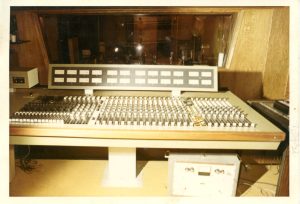 I was also the first to use transformerless differential inputs and outputs at every stage. That way I could maximize the dynamic range and immunity to interference.
I also used wire-wrap technology instead of soldering. It's actually more reliable than soldering.
I also figured out that the gain structure used by everyone else was not optimal. First you have an amplifier (typically 50 dB) to boost the small signal generated by the microphone up to a useful level. Then they have a fader, which is necessary to be able to control the signal level in real time. The typical average loss of signal going through the fader is 20 dB. More gain means less dynamic range, S/N ratio. and distortion.
The Clover Console used a variable gain amplifier instead of a fader, so you only had to use the minimal amount of gain.
One drawback was that a normal potentiometer that uses a logarithmic "audio" taper, is unusable. You need a different taper. So I had to make my own "faders" to properly control the gain.
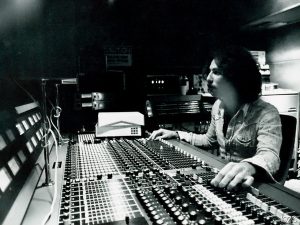 It was definitely ahead of its time...!
I didn't do much recording at Clover Recorders, but I did meet a few people there.
Robert Appère
Robert was the chief recording/mixing engineer at the studio. Chuck hired him away from A&M records. He made a lot of good records and later went on to record movie and TV sound, where he won 2 Emmys.
Groupies
In all my years in the record business, I only saw groupies once. They never came to recording studios, and I never went to concerts.
Across the street from Clover Recorders in Hollywood was "Studio Instrument Rentals" (SIR), which rented musical instruments to studios. They also rented rehearsal rooms to bands from out of town who needed a place to rehearse. One day, the Rolling Stones were in town for a concert and were rehearsing at SIR. Outside on the sidewalk were about 10 gorgeous young girls hoping to meet the Rolling Stones. To my surprise, they were beautifully dressed, and groomed. Really classy. Not like the image many people had.
Iron Butterfly
One day at Clover Recorders, a guy showed up to visit the members of Iron Butterfly. I don't remember if they were recording there as a band or what.
Anyway, he presented Iron Butterfly with 5 very nice bibles with genuine pigskin binding, gilt edges, and each of their names embossed in gold on the covers.
After a little chit-chat, the guy left, and the band tossed all the bibles into the trash! I'm not religious, but I thought that was a terrible thing to do; they could have at least given them to someone who cared. I fished the Bibles out of the trash and still have 3 of them.
Spinal Tap
The activities in the studio were always entertaining. I always wanted to make a real-life documentary film about the goings-on in the recording studio. It was just like the movie "This is Spinal Tap". I'm not exaggerating!
Robert Appere had a tape someone made of hilarious moments in the recording studio. One of the best was the Troggs, trying to count off a song.
On the very first note, one of the members stops the band, and starts shouting "didn't I just tell you not to do that"! After several minutes of shouting, swearing, slamming doors, etc. To make a long story short, this repeated several times, and they never did get past the first note!
If anyone knows where that tape is, leave a comment.
One issue is that there is a tremendous amount of pressure on the artists. Their entire career and potentially millions of dollars, depend on the success of their record!
====== spell check ens here =====
I partied with Keith Moon...
Keith was the epitome of rock & roll excess. The wildest man ever. Sounds really exciting, but there's no good story to go with it. It was the mid to late 1970s, not long before Keith died. Steve Cropper invited me to a party at Lee Householder's home. I never did figure out why, At the time, Cropper was working on a Keith Moon record at Clover Recorders, and I guessed that he wanted me to meet Lee, who was a record promoter of some sort. I showed up, and the only person I knew there was Bonnie Bramlett, who was drunk and hanging all over Keith. I decided not to say "hello" to Bonnie, even though she was a fan of mine, as it was embarrassing. It really was rude of me.
Interestingly, Keith was seemingly completely sober and was very calm. I never did meet Lee and left early as I didn't know anyone there who was sober, and I am a professional party-pooper.
Linda Ronstadt
One day, there was a knock at the door of the studio, and when I opened it, it was Linda Ronstadt. This was around the height of her popularity, so I was a little surprised. She was alone and wearing bib overalls and no shoes.
I couldn't help thinking, "Gee, they really fixed her up", as I thought about her publicity photos.
It seems she was visiting her friends from her old band, the "Stone Poneys", who were recording there.
Karen Carpenter
Another time, I ran into Karen Carpenter at the studio,
She was really tiny and quite friendly. I noticed that she wore a drum key (used for tuning drums) around her neck on a chain. I interpreted that to signify that she was more proud of being a drummer than a major singing star! She was a hell of a singer, though, as was Linda.
Average White Band
Many good records were made at Clover Recorders, but the only two hits that I remember from when I was there are "Pick Up the Pieces" by the Average White Band, and "Laughter in the Rain" by Neil Sedaka
Neil Sedaka.
Neil told me that he had written over 3000 songs and had 100 of his songs recorded and released.
Electra Records
I worked briefly at Electra Records in Hollywood, the home of Judy Collins and The Doors.
One day at a staff meeting, one of the producers suggested that we should paint the inside of the echo chamber yellow. Everyone was a bit confused, and asked, "Why?" It seems that this producer had worked in some studio that had a great-sounding echo chamber, and it turned out that the inside was painted yellow!
I tried to explain that color could not possibly affect the sound, and furthermore, there is no light in the echo chamber, and therefore, no color. Remember: all of our senses are subjective.
Robb Royer
While at Electra, I met Rob Royer, the co-founder of the band "Bread", who had some big hits. The other founder was David Gates, who was a buddy of Leon's from Tulsa. I don't think David and Leon were ever good friends, but they were both very talented.
I became good friends with Robb and built a console for his home studio in Brentwood.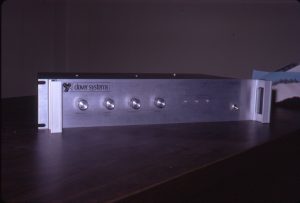
I engineered a few small sessions there, and we worked well together, so Robb suggested we form a production company titled "GRRR" after our initials. That never happened, but it could have been good.
================
Other Random Encounters
=== Experience With the Law===
Over the years, I have developed a great respect for our legal system, as a result of my experience.
Maurice-- bald tires
Wile working at Clover Recorders, I had sold my Carmen Ghia, and was driving Laurel's Buick. I had no real source of income, and I got a ticket for having bald tires on the car.
I didn't do anything about it becasue I didn't want to spend money on tires. But it turns out that that is a crime, so I ended up in jail! The holding cell in the Van Nuys jail was about 20 feet square, and had a telephone on the wall.
There were a few other guys in as well, but we all kept to ourselves. Then in came a new guy, "Maurice". He is freaking out and behaving very suspiciously: "I gotta get outa here, I gotta get outa here, I'm wanted for murder one!".
I'm thinking to myself, "Great, I'm locked up in a cell with a panicked murderer!" Maurice made a phone call or two that went something a little like this: "Yeah, baby, I know I said I was gonna call, but I got busy, and..." Obviously he was trying to get one of his girlfriends to bail him out, but they were not going for it, which I thought was hilarious!
After a few minutes of this, I couldn't stop myself from bursting out laughing! Luckily, "the killer" had a sense of humor.
By now, I'm figuring out that his "wanted for murder" ruse is a self defense mechanism. I presume every one in jail or prison pretends to be a dangerous maniac so that the other prisoners will leave them alone.
I remember the "Satan's Slaves" motorcycle gang in Van Nuys also tried to act tough and dangerous so people would stay clear.
I don't know how "Maurice" made out, but after about 4 hours, Laurel came and bailed me out.
Lesson learned.
==========
IRS -- I also had an educational experience with the IRS:
It seems that I owed the IRS $750 on my income taxes. I didn't give it much thought, all I knew waw I didn't have $750 (if I did, I wouldn't have bald tires on my car), so I can't pay you today, but I will pay you just as soon as I am able.
Then I receive a request to come visit their Van Nuys office, which I did. I calmly expained that I didnt have $750, but will gladly pay as soon as I am able. The agent then says "How did you get here?" I reply "I drove". He then says with his hand held out "Oh, you have a car???"
Suddenly everything is chrystal clear. I managed to convince the agent I could borrow the money, and excaped with poor Laurel's Buick.
I was able to borrow $750 from my neighbor Reggie Fisher, and l learned a couple of valuable lessons.
Inventing is a tough business!
==========
Spherical Sound
The Trial
LBR Trial
==== Chapter 5 =========
Beach Boys
After completing the Clover Recorders console, I was sitting on the couch in my living room trying to decide what to do next when the phone rang. It was Steve Moffat, who I knew from Sound City, a recording studio in L.A. He said " How'd you like to go to Switzerland with the Beach Boys?" I quickly replied: "OK".
The idea was that the Boys were sick of LA and wanted to make a record in some other environment. They were going to rent a castle in Switzerland, set up a studio, and make a record. Soon, the plan changed from Switzerland to Holland. Attached is a booklet that Warner Bros published that will explain the situation. You really should read this first, so you can see the scope of what we were up to, and also so I don’t have to write a lot.
Before leaving for Holland, I visited Brian's house in Bel-Air. It was a beautiful house. Single-story Spanish revival style. Entering the house, the entire floor of the house was ankle-deep in cables. He had set up a home studio (just like Leon), but the difference was that he had microphones in every room, including the bathrooms. My analysis was that he made fame and fortune as a songwriter, so he was paranoid about having a song idea and then having it slip away before he could record it. I witnessed this in Holland too. He was obsessed with recording every song idea that popped into his head. He also liked to experiment with different recording techniques. In the early '60s, Brian and Phil Spector were the only people innovating in making records.
Warner Bros. published this booklet about the adventure, which may give you an idea of the magnitude of the project.
The Holland album was quite an undertaking. I designed and built a recording console from scratch in a couple of months. When it was time to move to Holland, getting Brian to Holland was a challenge. The story I was told was that on the first try, Brian got up out of his seat on the airliner and walked off the plane at the last second. My recollection is that that happened a second time, so on the third try, they handcuffed Brian to the seat of the airplane.
I had very little interaction with Brian. I'm not sure anyone did, as he was practically catatonic. My main interaction was with Carl and Dennis. I never even met Mike Love or Al Jardine. The three brothers were quite different from the typical rock stars. They were very down-to-earth regular folks.
Dennis was the most naive person I ever met. I mean that in a good way. You probably know the story of Dennis and Charlie Manson.
One thing that surprised me was that they were the biggest act in show business and earned tons of money, so one would expect they would marry supermodels or movie stars. But I considered the fact that they didn’t a big plus. They were not the shallow, aspiring rock stars you typically see in Hollywood.
I was never a "fanboy," so I didn't know much about them. But I found them to be refreshingly normal, down-to-earth folks. I used to say, "If they weren't huge stars, they would be pumping gas in Hawthorn."
At this time (~1972), Brian was declining. I heard that he once spent 6 months in bed, never leaving his bed. Anyway, it seems like a sure sign of depression. He obviously didn't particularly want to go to Holland; I think the brothers felt that a change of scenery would help.
Brian was a pretty big guy, maybe 6'2" or 6'3". He would look around the room like he didn't know where he was. He would wander off and get lost too: one night we're recording some tracks in the studio, and there’s a knock at the door. I open the door, and there's Brian and two cops. The cops said, "Do you know this guy?" We answer, "Uh... Yeah." He would wander off and didn't carry identification or money. I think he made it back to the studio only because he was famous and people knew who he was.
As I mentioned before, it was clear that he was obsessed with capturing his song ideas. One night, the band is in the studio recording rhythm tracks, about 2AM, when Brian walks in. He walks into the studio while tape is rolling, oblivious to the fact that there is a band recording. He sits down at the piano and starts playing something entirely different. The band stops, and in a moment starts playing along with what Brian is doing. My take was that he was completely unaware that there was a band playing in the studio.
Brian Wilson’s Birthday Party
Brian had a birthday while we were in Holland. The Boys had an entourage of advance men, publicity men, etc., who arranged a party. Travel by canal is common in Holland, and the country is filled with canals. Amsterdam has a main canal with glass-topped tour boats. They rented one of these tour boats for a night, and we all went for a ride on the canal. The advance men are pretty good at arranging things, and they somehow hooked up with this local guy "Christian". He had a suitcase, which was filled with hash pipes of all sorts, and a chunk of hashish the size of a softball to go with it. Marijuana was pretty much unavailable in Europe then, but hashish was fairly easy to come by. Although not legal, smoking hash and marijuana was tolerated by the authorities in certain places in Amsterdam.
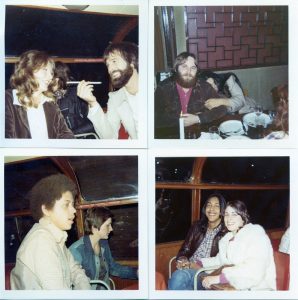
Brian’s Birthday Party
Anyway, Christian got us all stoned out of our minds! We had "English Joints", which are made from about 6 rolling papers and filled with a mixture of tobacco and hash. One popular version was a fat joint about 6" long, with a hole in the center. You light both ends and suck through the hole in the center. Two giant hash joints at once! Even better was the electric hash pipe: it was made from a small battery-operated vacuum cleaner hooked up backward, with a funnel in the input where the input hose would normally go and a mouthpiece on a hose at the output. Christian put a huge piece of hash in the funnel, and it could pump a year's worth of smoke into your lungs!!
By the way, Brian never showed up for the party. He probably got lost on the way!
Dr. Landy
The most interesting Beach Boys story is about Dr. Landy. That story has already been pretty well documented, including a couple of TV movies. But it's a great story! It's basically the story of Svengali, who takes over the life of a young girl with the promise of fame as a singing star. This seems to be a common story in real life, where people succumb to the promise of fame and fortune.
Even in 1972-3, Carl and Dennis were very worried about Brian's condition. He was really a basket case. One day, Laurel asked Carl and Dennis, "What happened to Brian?" I probably wouldn't have had the nerve to be that blunt. They answered in unison, "We don't know!! We took all the same drugs; we did all the same things; it's a mystery!" But they were sure that if nothing were done, Brian would surely die. And I think they were right.
So after returning from Holland, this led to the hiring of Dr. Landy, a psychologist who claimed he could cure Brian. His strategy was to just force Brian to behave. Forcing him to act normal would make him normal. I guess he figured that Brian's ability to do whatever he pleased led to a disconnect with reality.
Dr. Landy hired people to watch over Brian 24 hrs / day. One guy's job was to sit in a chair all night and watch Brian sleep. At dawn, Brian would be physically hauled out of bed, dressed, force-fed breakfast, etc.
Eventually, he was forced to write songs, record music, participate in TV shows, etc. I remember one TV show that was supposed to be the "Return of Brian". Brian was so miserable it was heart breaking!
Brian's life was completely taken over by Dr. Landy. He made Brian write songs, record them, etc. Gradually, Dr. Landy's name started appearing on songwriting credits, bank accounts, etc. You can find the details elsewhere, but the beauty of the story is that on the one hand, Dr. Landy did a terrible thing, exploiting Brian for financial and personal gain, making him miserable, and ruining his life, but on the other hand, everyone agrees that otherwise, Brian most certainly would have died! He ruined his life and saved his life at the same time!!
Eventually, the family got rid of Dr. Landy, but it's a great story!!
####
Kangaroo Boots
-- On my way back to California from Holland, I stopped in London to visit my old home in Cambridge. I was in my hotel and figured it was time to get ready to head to the airport. I was sitting on the edge of the bed, putting on my socks, when suddenly I was hit by lightning! Many of you may have had a similar experience of sudden and severe back pain. I collapsed on the floor and couldn't move! Now I'm lying on the floor thinking, "What am I gonna do?? I can't even get off the floor, much less somehow make it to the airport, and then a 12-hour flight to Los Angeles! I figured that even if I can make it to the airport, I'd better not get on the plane, because if I have another attack on the airplane, they will have to turn around and return to London. What a dilemma!
Slowly, the back pain receded some. After a while, I figured I could probably make it to the airport and can decide the next step when I get there.
When I got to the airport, it turned out there was an airline strike! No flights could take off! The strike lasted another 12 hours or so, and the terminal was jam packed with people, so all I could do was lie down on the floor! It could be that lying flat on the floor may have helped my back... but it certainly was uncomfortable!
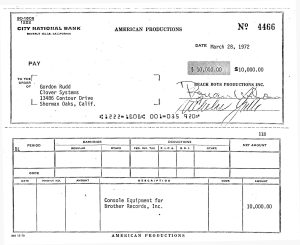
Brian’s Autograph
Eventually the strike ended, and flights could resume. I was still debating whether I should get on the plane, though, because if I have another attack, I'll be rolling on the floor screaming in pain, and the plane will have to turn around.
As it happened, I took a chance and was able to get on the plane, and my back gradually improved over the next 12 hours. A very close and scary call! It turns out the worst thing about it was that I was in such a panic to get to the airport, I left my Kangaroo cowboy boots in the hotel room in London! They were really good boots too...
=========================
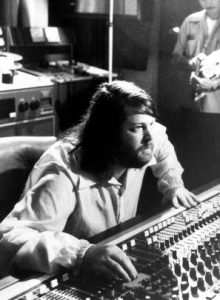
Brian at the Clover Console
=====
Brian at the Clover Console
1. John with “English Joint”
2. Carl Wilson
3. Blondie Chaplin
4. Ricky Fatar
Laurel & I relaxing in our Heemstede Mansion
Brian’s Autograph…
This was a down payment on a $60,000 recording console. ($474,000 in today's money).
Brother Studio in Santa Monica
After returning from Holland, Steve built a studio for Brother Records in Santa Monica, on 5th street.
My Shop in Arleta
================
Chapter 6 Digital Audio
While at UCLA, I figured out that recording and storing music in digital format offered many advantages over the tape recording we had now.
It became sort of a crusade for me to build a business around digital recording of music, so I was always looking for people who could help me promote this revolution. I was always shocked at how few people ever expressed any interest.
John Scantlin -- Scantlin Electronics/Transaction Technology.
Since 1968, I have always been trying to promote the idea of digital music. One of the first people I pitched it to was John Scantlin.
In 1970, I saw a classified ad in the Los Angeles Times saying "Design Computers in Bel-Air" I didn't know anything about designing computers, but who could resist such an offer?
I responded and was granted an interview with John Scantlin of Scantlin Electronics, who indeed had an office in Bel-Air. I told him about my idea to record music digitally, thinking he might be open-minded enough to listen.
It turns out in the '60s Mr. Scantlin had built what was then the largest computer network in the world, the Quotron network, which transmitted stock market quotes all over the world. Every stockbroker in the world had a Quotron terminal on his desk. I find this interesting because it mirrors the first big success of Thomas Edison.
The New York Gold Exchange in those days, used teenage boys as "runners" who carried slips of paper with the current price of gold to brokers in the city. Someone had the idea to replace that system with a network of telegraphs. It would be faster and cheaper than the current system.
The trouble was, it didn't work reliably. By this time, Tom Edison had built a reputation as a young man who was well versed in telegraphs, and they hired him to try to fix the system. I don't remember what the problem was, but Edison was able to fix it, and earned a $5,000,000 reward! In the 1890s, that was a huge amount of money and the beginning of Edison's fortune. I wonder if Mr. Scanlin got the idea from Edison?
When I met him, he was forming a new company, Transaction Technology, Inc., with backing from CitiBank, one of the largest banks in the world. Their mission was to create a network of automated teller machines, so he was one of the inventors of the ATM!
Although he was very hospitable and we had a good talk, at the end of our meeting, his exact words were, "If it were possible, IBM would have done it by now." I didn't argue about the feasibility because I didn't want to be rude, but it was clear he didn't get it. I guess the music business wasn't as attractive as the banking business...
===============
Insert the popup "Feasibility Study..." here
=================
Digital Audio Workstation
Digital Audio Workstation—DS16
In 1985, I connected with MicroTechnology Unlimited, a company formed by David Cox and Hal Chamberlin to develop and market microcomputer and digital audio products. Hal Chamberlin had written a book, "Musical Applications of Microprocessors," that was quite popular. A lot of people started to realize that computers could be used to make music.
I had not been especially interested in computers until I discovered that computers could be used to make music. I even put together what I called a "Computer Music Studio" in the Paradise Records facility where I was working at the time.
It consisted of a multi-voice Emu synth, and a DEC LSI-11 computer.
With the rapid advancement in magnetic disk drive speed and density, suddenly my goal of a digital tape recorder became obsolete.
I somehow hooked up with David Cox, and became a re-seller of the DS-16 A/D, D/A converter. At that time, I believe it was the only 16-bit converter that you could actually buy.
I designed and made an ISA bus card for the IBM PC, which would interface with the DS-16 and record 16-bit audio directly to disk.
=================
================
SoundStream
5/1975 -
When I was making Clover R500 reverbs, I hired Greg Hanks, whom I knew from Electra Records, to help me,. That venture was eventually a bust thanks to Michael Leone, our investor, who absconded with all the assets. I could have made a lot of money!!
But Greg introduced me to Cynthia Steinberg, who worked at the business consulting firm of McKenzie & Co., the top business consulting firm in the U.S. I guess I told Cynthia about my desire to record music digitally, so she introduced me to Randy Cole, who
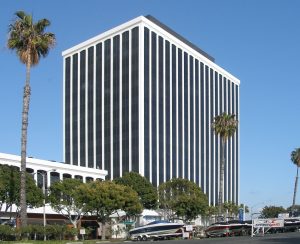
USC ISI
worked at the USC Information Sciences Institute (who then actually ran the ArpaNet, later to become the internet) and who introduced me to Prof. Tom Stockham, the head of the computer science department at the University of Utah.
The USC ISI was an interesting place: they occupied the top 2 floors of a fancy building in Marina Del Rey. One of the floors was completely filled with DEC PDP-10 computers, which at the time was DEC's most powerful computer. At that time, it was the hub of the ARPANET, which later became the Internet.
It was there that I saw a laser printer for the first time. It was made by Xerox and was 6' tall, 3' wide, and 8' deep. It printed about 2 pages per second! I don't remember if they were double sided, but it looked like it could print an entire book in about one minute. Never saw anything like that since.
Turns out Prof. Stockham was doing the same thing I was; trying to raise money to develop digital recordings of music. Finally, I found someone who had the same goal as I! He did eventually hook up with some backers, one of whom was Malcolm Low, co-founder of KLH Audio, a well known audio manufacturer. Prof. Stockham had just formed Sound Stream, Inc. in Salt Lake City.
I've always said that Tom Stockham was the smartest man I ever knew. Tragically, Prof. Stockham died of Alzheimer's disease at the age of 60!! I like to think that he used his brain too much and wore it out!
Dr. Stockham hired me to drum up some interest in his plan. He had already built 2 16-bit A/D converters, which at the time may have been the only ones in the world. He also made a demonstration tape at the university to demonstrate the spectacular sound quality. He gave me a cassette copy of the recording to demonstrate to people in the record business. Apparently, I was the only connection to the actual record business that SoundStream had.
Unfortunately, I am the world's worst salesman. Most people are happy with what they already have. They can't visualize the advantages of a new way of doing things. Although I knew some people who might have an interest in this, most of them didn't have the wherewithal to help found a serious business.
Some of the people I contacted were The Record Plant, George Martin, and Leon Russell.
Record Plant
seemed like a good prospect, as they had two locations: one in Hollywood and one in Sausalito, and they had an influentual clientel.
Chris Stone, Gary Kelgren
They were well known in the music business and had many big clients. They flew me up to Sausalito to discuss some kind of collaboration. We didn't discuss all the advantages of digital recording, but instead, they pitched the idea of SoundStream installing a system in one of their studios in Sausalito, California. Chris Stone was a marketing guy, and my feeling was that they thought it was a gimmick that could be used to attract customers. And well it should have. But they wanted it as a free trial, and Dr. Stockham didn't go for that. Both sides needed to generate income.
Gary Killgren was Chris Stone's partner and a colorful character. I guess he was a good recording engineer, as he had many important credits. But his real talent was in creating a pleasant environment for the artists. At the Sausalito studio, he had one studio where Gary and his console were at the center of the room (no glass wall or control room), and the band was distributed around him. I interpreted it as a desire to be "the center of attention".
Another quirk of Gary's was that he could not go two minutes without snorting cocaine. It was embarrassing in the presence of Prof. Stockham, the head of a major department of a major university. No one really cared; it's just that Stockham and his partners may have asked themselves if this is a guy they want to get involved with.
Tragically, a few years later, Gary drowned in his own swimming pool.
George Martin
Pam Bishop, who was the studio manager at Clover Recorders, had some contact at George Martin’s office in Hollywood and set up an appointment for us to talk to him. Prof. Stockham, Bob Ingebretson, and I went to his office and had a nice conversation. He was a real gentleman, and was very nice to us. Not at all like the typical Hollywood record producer,or the folks at Record Plant. He listened politely to our pitch, and afterward said, "That sounds great, but I'm just a musician, and I don't even know what you're talking about, so I don't know how I can help you". Those were his exact words, and my favorite part is "I'm just a musician". That really made an impression on me. I guess the problem in those days was that musicians were not really interested in radical new technology.
Judy GarlandSoundStream also had an audio restoration process invented by Prof. Stockham. It was a process he called "blind deconvolution". It was an incredible process, and was also used to restore images. NASA used it to enhance photos from the moon.
Convolution is a sort of filtering process. If you know the filter characteristics, you can "undo" the filter. "Blind deconvolution" is a process where you can undo the filter without knowing what the filter process is.
Prof. Stockham used this technique to restore some Enrico Caruso (mechanical) recordings for RCA. These recordings were made before the invention of electrical sound recording, so they were quite noisy and distorted.
So, I was trying to promote this as a restoration service as well as the digital recording. Someone at my studio introduced me to Sid Luft who was a Hollywood movie producer and Judy Garland's third and last husband. He was looking for someone to restore some old Judy Garland records.
I met with Sid at his apartment on Wilshire Blvd. and tried to explain what we could do. His apartment was pretty ordinary but in a good neighborhood. He had a vintage Mercedes-Benz cabriolet, which was pretty cool. He had only a few Judy souvenirs, which surprised me. The only pictures on the walls were of horses!
He had a gorgeous, young, tall, slender wife, who was very nice to me and even made me dinner. I asked Sid how he met her, and he told me he met her while standing in line at a Las Vegas show. I didn't say anything, but she was obviously a Las Vegas showgirl.
I also asked Sid how he met Judy. I can't swear this story is true, because I wasn't there, but it's believable (this was around 1950), and straight from the horse's mouth: he said he was in some nightclub, and he spotted Judy at another table with some guy. He decided to talk to her, and walked over to her table and introduced himself. After some casual chit-chat, he pulled a revolver from his pocket, put it to the guy's head, and said, "Why don't you take a walk?" And the guy did! And Sid ended up married to Judy!! I guess she liked that sort of thing...
Judy's official biography omits the gun part, but who knows? All I know is what Sid Luft told me.
Demos
I took a 16-track Beach Boys master to Salt Lake City to experiment with. As well as a James Last master given to me by Record Plant, so see what we could do. Bob Ingebretson made a Digital Audio Processor program that ran on their DEC PDP-11 computer, and could mic 16 tracks of music, but not in real time.
Chapter 7 Music Video
Steve Moffit (from Sound City) introduced me to Jorjana Kellaway, wife of Roger Kellaway, who had a cello quartet. She was involved with Moorpark College in Moorpark, CA, north of Los Angeles. The college was originally an agricultural college, but due to its proximity to Hollywood, it had a rather good program in media arts.
Jorjana got me hooked up with Moorpark College to create and teach a music recording course. It was fun teaching young kids about recording music. I suspected that most visualized a life of glamor and Lamborghinis, but there were a couple that were seriously interested in a career. and did well.
I found it a good exercise for myself too: I was paranoid about telling these poor kids something that was not true, so I went out of my way to make sure everything I taught was correct.
At the end of the course, I took the class to the Beach Boys' studio on 5th St. in Santa Monica. It was a nice studio, and my Clover Console was installed there. I think they enjoyed that.
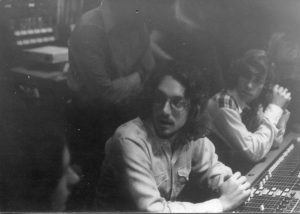
Class field trip to Brother Studios
One of my students at Moorpark College was Dick Jones, who was manager of a TV studio in Santa Monica, owned by GTE. He enrolled in the class to learn more about his studio. He was also having some trouble with an audio recording (voice-over) studio, and Dick hired me to see if I could fix it.
The problem was a design error in the console, and was easily fixed. But it illustrated how GTE was duped into paying a lot of money for bogus equipment, which is why an accountant was put in charge of the studio.
So now Dick hired me as a technical director for the whole studio. It was a real professional film/video/audio studio with a huge sound stage, video and film editing equipment, a voice-over/studio, and remote video recording and broadcast.
They produced training films, documentaries, and television commercials. I learned a lot about video, and worked on many interesting projects.
One nice thing about GTE was they had money. GTE (General Telephone & Electronics) was a huge enterprise. The studio in Santa Monica was media support for the rest of the company. They produced training films and videos, promotional videos, and TV commercials.
Paradise Records
Around 1975,?? While I was promoting SoundStream and digital recording, one of the people I thought to approach was Leon Russell.
I worked with Leon on & off for 10 years, so I thought to call him up and pitch my digital recording idea. I went to his house in Encino, where he had a studio, to play a tape for him that was a (16-bit) digital recording of drums that prof. Stockham made at the University of Utah in Salt Lake City. This recording had the most presence of any recording I'd ever heard.
Roger Linn had toured with Leon as a guitar player, and was now working as the "house engineer" at Leon's home studio. The same position I had in '66-68, so he was also there. Leon had an amazing array of musical instruments and sound synthesizers.
One thing I learned from the sound synthesis business is that sounds in real life are EXTREMELY complex. Even the most complex and intricate analog synths could not really create a decent violin or trumpet. It was now my premise that it would be easier and more effective to play back a recorded sound than to try to synthesize it. There were several instruments that tried to do that, but they used tapes, and were such poor quality that they had limited usefulness (I also contributed to the design of the Chamberlin organ, around 1971). and started to build an organ with recorded tapes while at Skyhill.
I like to think that my demo influenced Roger to try digital drum sounds.
Leon also had a PIAA programmable drum machine that was the first programmable drum machine that I ever saw. It was pretty amazing, and sold as a kit for $69. Its only shortcoming was the analog sounds. As I recall, Leon once made an entire album using that drum machine (or maybe it was a Roland?). Anyway, after that, I went to work again for Leon, building three studios.
Another Sea Change...
Leon wasn't interested in my digital tape machine, but he did like the fact that I had experience with video production from GTE. Leon had just disassembled his record company, Shelter Records, in Tulsa, which included a lot of video equipment. Leon figured out in the early '70s that video was the future of music. This was long before MTV or anything like that. Leon worked on the Shindig TV show, and knew that TV was a powerful thing.
This was shortly after Leon's successful Joe Cocker tour "Mad Dogs and Englishmen," so he was flush with cash.
Leon soon moved out of his Encino home / studio, and moved to a house in Toluca Lake. He also bought a building in Burbank to house all his "stuff", which was plentiful.
He had enough stuff to build 3 studios, plus a touring sound system, antique cars, antique furniture, etc. etc.
The plan, as I understood it, was to build a new studio, form a record company, and make some records.
So I failed to sell the digital recording business, but Leon sold me on joining his record company, "Paradise Records".
Leon already had a design for the studio, made by xxxxxxxx a well known studio acoustics designer. It was a good design, and all ready to build.
But Leon had a funny way of doing things. I knew from the start that he could never do anything the normal way, but I could never figure out what his plan was. I don't think anyone else could either. Leon never told anyone what his real plan was.
Leon was like the Winchester woman, who believed that if she ever stopped building her house, she would die.
We eventually ended up building 4 studios, and 2 remote trucks.
And the plans changed every 5 minutes. Just as I was preparing to put together Studio A, Leon decided not to use the original plan, but instead cobble together a crude control room in the warehouse and use the whole warehouse as the studio. Then he decided it needed a stage.
We built a stage at one end of the warehouse that was raised a foot or more. We bought a set of theatrical lights with a control panel and set it up. But with the stage, there was inadequate room for the lights.
Leon had a touring sound system consisting of Peavy gear.
He also had two recording consoles: an API. board that was pretty conventional, and a Helios console that I presume he bought in England when hanging out with the Beatles.
Jim Mankey and I spent a lot of time re-commissioning the Helios board that was eventually installed in the warehouse.
Leon insisted on footlights.
Studio A
Studio B
Woodbridge Studio
Studio C
My Office
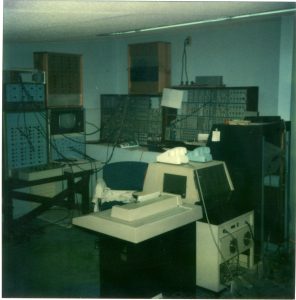
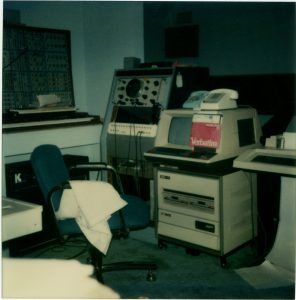
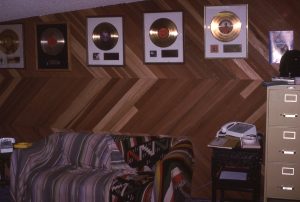
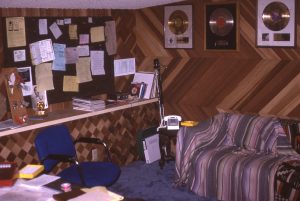
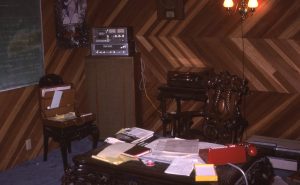
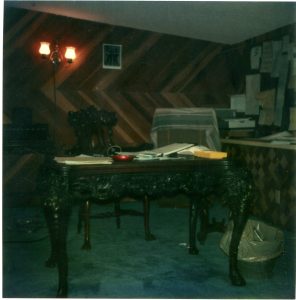
Jack Jester
I knew Jack Jester from GTE. He was an experienced "Outside Broadcast" guy who had a lot of equipment of his own, and had broadcast John F. Kennedy's presidential campaign in 1960.
I figured that his experience would be invaluable, and hired him to organize our video buses and studio.
Leon liked everything to be portable. So we built two mobile studios:
80-track recording
6-machine video recording & edidting
===================
Willie Nelson
Around 1979, we recorded and videotaped 107 songs with Willie Nelson and his band, in two weeks.
It was great to record real music in real time with no overdubbing or even second takes. I don't know what ever happened to those tapes...
It took place at the Woodbridge studio, as that was the best studio at the time.
One thing I remember about Willie was that he would sing any song, anywhere, anytime. It seemed like all he wanted to do was sing and play the guitar.
We had Willie's whole band and entourage, including two drummers and a full-time cook. He had a whole self-contained traveling operation.
I don't recall using two drummers on any of the songs. The deal was that at some point, Willie decided that he wanted a different drummer. But he refused to fire the old drummer, so he kept both. Another example of southern loyalty.
I also remember Mickey Raphael. I was always a fan of harmonica players, so it was a treat to work with Mickey.
I remember being a bit disappointed, though: I felt like he was playing the same thing on every song. But some time later, I heard a Mickey Raphael record that was the most imaginative harmonica playing I ever heard! I guess he was playing what Willie wanted, which is good.
Some that I met or worked with at Paradise:
Willie Nelson
James Caan
George Harrison
Mickey Raphael
James Caan -- At the end of the two week recording session, Leon invited some people to the studio to celebrate and maybe find an outlet for the recording, and James Caan was one of the attendees.
I don't know what happpened to those tapes; if you know, please let me know in the comments.
===================
Chapter 8 Other Random Encounters
Electra Records
At Electra Records studio, I met Robb Royer, a founding member of the band BREAD. We became good friends, and I built a recording console for his home studio. We were going to found a production company, GRRR, from our initials.
I also built for him a "dynamic processor" that was a combination of a dynamic expander, compressor, and limiter. The effect was controllable for each volume range: the expander works at a low level, the compressor works at a medium level, and the limiter works at a high volume.
Rod Stewart
Around 1970, I worked for a time at Cherokee Studios in Hollywood. It was interesting in that their client list read like the Hot 100. I don't know how they did it, but they attracted many of the top recording stars in the business.
One of them was Rod Stewart, who made some great records. I never worked with him, but I did witness some of the aftermath of his sessions.
In addition to breaking a lot of microphones and other stuff, he covered the walls of the studio with huge felt pen drawings of penises. All sizes and shapes; some were as much as 5 or 6 feet long. Dozens of them. I know this is true 'cause I saw it with my own eyes. Strange guy; he seemed to be obsessed.
The one drawing that caught my attention, though, was only a couple inches tall, and had a caption:
"My Sister Pulling Up Her Drawers"
I thought that was quite odd, and I remember it to this day.
Interestingly, Rod Stewart was one of the few male singers that I liked! His records were great!
Out of all the big name acts recording there at the time, the one that caught my attention was The Cars. Ric Ocasec
They had one tune, which was one chord all the way through, then, on the fade-out, it resolved! I thought that was pretty clever.
John Belushi
Steve Cropper invited me to a Blues Brothers session at Cherokee Studios one day. I had worked with that band at STAX, so it was kind of an "old times" event. But it was very different from the old days. This was 1979 or '80, and Blues Brothers was a big deal. The studio was filled with all kinds of movie studio people, so I took a seat in the back of the control room right next to John Belushi. I never got a chance to introduce myself (not that I would have), because all he did the entire time was talk on the (landline) telephone. I remember this because at the time, I thought that was really strange behavior. He didn't seem to have any interest in what was going on in the studio. It also didn't seem to be a friendly call. This is all just my impression, but my experience was that celebrities often do this to avoid anyone talking to them. I also got the impression that he felt like a fish out of water.
"I terrified Steve McQueen..."
In the mid-'70s, I was living in Sherman Oaks in LA. One day, I was headed to some shop on Ventura Blvd. in my E-Type Jaguar. In those days, it was my "daily driver". Anyway, I parked at the curb, and as I got out and stepped up on the curb, Steve McQueen and Ali McGraw came out of a liquor store right in front of me.
We were face to face, literally an arm's length from each other. I immediately recognized them, but didn't say anything. I could see a look of terror on his face and a "thought balloon" over his head like in the comics, saying, "Oh no, please don't say anything!"
Steve was very protective of Ali, who didn't even see me. He shielded her from me, while she just stared at the ground the whole time.
Another example of the horror of being a big star.
Larry Hagman
Around 1980, my friend Pam Bishop invited me to a filming of the "Dallas" TV show. It was in a local soundstage, but I can't remember which one. Could it have been Warner Bros.? This was pretty much at the peak of Dallas hysteria, as the most popular thing on TV. It was a really big deal. It was so big that it practically ruined his life. He couldn't go out in public, or have any real life.
As I entered the sound stage, there was a doorman inside, who said to me, "Whatever you do, don't look at Mr. Hagman." I was surprised and a little confused. I wasn't sure how to interpret that, but I guessed that it meant don't stare at or make eye contact with Mr. Hagman.
I quickly learned that no one was allowed to speak to or have any interaction with Mr. Hagman, even the crew! There was no direction by the director or any of the crew.
As a result, the whole thing was pretty boring, so I left after one or two scenes. Just before I left, the scene ended, and Hagman headed out of the sound stage to his dressing room without a word, like all big movie stars do. I was standing right next to the door, so Hagman walked right past me, just a foot away. I looked him right in the eye, and he looked at me right in the eye. I thought, "Uh-oh, I'm not supposed to do that", but nothing happened. I imagine he was checking me out to see if I had a weapon, and was going to assassinate him! Probably the most paranoid person I ever saw.
Entering the post office parking lot, I spotted a yellow Lamborghini parked near the entrance. I parked, then got out and checked out the Lambo. It was rare to see anything like that in my Laguna Niguel suburban neighborhood.
When I went inside, there was a girl in front of me in line. She looked like she was about 12 years old, and dressed in authentic 1965 hippie costume! Her outfit included Birkenstock sandals, and a homemade leather purse, typical of the era. I don't remember many other details, but I do remember that her costume was 100% authentic hippie! It was absolutely Twilight Zone!
I followed her out the door when she left, and to my astonishment, she then walked over to the yellow Lambo, got in, and drove away! She honestly didn't look like she was old enough to drive!
My best guess is that she may have been an actress who was on a lunch break from the set. Any ideas about what was going on??
One day in the late '70s, I was driving down Ventura Blvd. in my 1962 red E-Type Jaguar. Suddenly I see an identical car coming the other way. Even at that time, it was pretty rare to see a car like that on the street.
As we passed each other, we both stared at each other, and I suddenly realized that it was Paul Newman!
The real shock was that he had white hair! At that time I was unaware that he had white hair; I only knew him from the movies!
===========
Chapter 9 -- Evolution of the Programmable Drum Machine
Around 1978, Roger interfaced his Radio Shack TRS-80 computer to a Roland drum machine to make it programmable. But it was limited to the analog sounds of the Roland.
companding converters -- I had experience with 16-bit digital audio at SoundStream, and started to build a 12-bit companding converter back in 1972??
Leon's house in Encino
Around 1975, I was promoting SoundStream Digital Recording. I had worked with Leon Russell for many years, and thought he might be interested, so I called him up and made an appointment. We met at his house in Encino, where he had a small home studio.
Roger Linn had
In those days, there was no such thing as a 16-bit A/D converter, and 12-bit converters were very expensive, as was the memory. So 8-bit was pretty much the only practical solution, so I introduced Roger to the 8-bit non-linear companding converters (the steps between the more significant bits are larger than between the less significant bits).
Linn Drum Computer: In trying to develop a digital tape recorder, I figured out that using a non-linear scheme would allow higher performance for less money. I even built a 12-bit companding converter back in ~1972. By 1979, there were 8-bit companding converter ICs available that were developed by AT&T as they were planning the digitization of the telephone network. I gave Roger a data sheet for the AT&T 8-bit companding D/A converter chip. This was a pretty important development for digital instruments, as it provided decent performance at a reasonable price. This scheme became the standard for all digital instruments for many years. So that was my contribution to the Linn LM-1 Drum Computer.
Roger started selling the LM-1 around 1980. Shortly after, I was hired (with Roger's help) at Oberheim Electronics to develop a digital drum machine, which became the DMX. The DMX predated the LinnDrum, and was the most advanced drum machine at the time. The LinnDrum came out later, and bears an uncanny resemblance to DMX.
((Oberheim’s negotiation with Roger))
How did I hook up with Oberheim?? I was already working at Oberheim.
Who requested the meeting??
Note that the prototype in the attached photo (which I still have), had two rows of buttons instead of the three of the production model. As soon as I sat down to play the prototype, it became obvious within a few seconds that it should have three rows of buttons! You can't anticipate everything...
After the DMX was finished and successful, Roger hired me at Linn Electronics as Director of Engineering (~1982-3). While there, I designed the Linn 9000 and ran the engineering department. Again, the Linn 9000 was by far the most advanced drum machine / sequencer at the time. I think my most interesting contribution to that project was the touch-sensitive (pressure sensitive) rubber playing pads. Nothing like that had been done before, and I see that they seem to be a staple of all following drum machines.
By 1985 I got sick of drum machines, and went on to other projects of my own, and got into the CD business. Attached is a photo of the original DMX prototype, which I still have. Also a photo of parts of the original breadboard DMX, which I also have. The other part of the breadboard was a board I designed and built that plugged into our GA-16 mini-computer that had the (non-linear) D/A and A/D converters I built. The software was GA-16 assembly language. All of the original DMX voices were digitized with this setup.
I always considered the drum machine to be a tool for composers. In those days, the only people that bought sound synthesizers were college professors and eccentric composers. According to Roger, disco music was also a factor in the acceptance of digital drum machines: Roger said that guys like Georgio Moroder and Herbie Hancock loved it because it could play 120 bpm perfectly FOREVER with high enough quality to use on records.
After Roger's LM-1 Drum Computer started to become successful, Tom Oberheim wanted to somehow get involved with the LM-1. Roger wasn't interested in a deal with Oberheim, so instead, Tom hired me.
I don't know how I got the job at Oberheim...
The negotiation between Roger and Tom was pretty funny: Tom asked Roger if he wanted to continue with his own company, or work with Oberheim. Roger answered, "I'd like to do whichever is going to make me the most money". And Tom replied, "You can make more money by doing it yourself". End of negotiation. I was quite shocked by Tom's response.
Oberheim Electronics
======
I don't remember how I got the job at Oberheim, although I think it had something to do with my association with Roger Linn and his digital drum machine.
To be continued...
See: Evolution of the digital drum machine.
Anne Graham -- It was love at first sight.
At that time, Oberheim was located in two locations in Santa Monica; there was the main office, and there was a shop elsewhere.
Later, we combined the two into one location at ...
Tom Oberheim took me to the shop to see where they were making the products. While there, I met a captivating blond girl, Anne Graham. I was hooked in the first 5 seconds. She looked me right in the eye, and I was sure that she could see my soul!
At first, no one ever mentioned anything about digital drum machines, but I suspected they might be interested.
One day, Tom caught me reading a book about the Pascal programming language. I had an idea that it might be helpful to come up with a programming language for programming sound synthesizers. At the time, the only practical solution was assembly language, because of speed and memory size limitations.
Tom suggested I take a look at the FORTH programming language. I didn't know anything about it, so I started investigating. It was invented by an astronomer to control his telescopes.
FORTH is a little esoteric, but I fell in love with it, and it was used for the development of the Linn 9000.
Eventually, Tom decided to make a digital drum machine, and I spent the next two years designing the hardware and software.
(Photos of breadboard & prototype.)
=======
Linn Electronics
Roger Linn
Roger was a smart and talented guy. I first met him at Leon's house in Encino, where Roger was "the house engineer", and Roger also played in Leon's band. I had come to Leon’s house to pitch him on the SoundStream digital recording. I played the demo cassette for Leon & Roger, and explained what we were trying to do. Although it was just a cassette recording, the demo had an incredible presence! It sounded absolutely live.
At the time, Roger connected a Radio Shack TRS-80 to a Roland drum machine, which of course was analog sounds. But in enabled him to program much more complex rhythms than the standard drum machines. I like to think that the demo may have influenced Roger to try digital drum samples.
================
Chapter 10 OPTICAL DISCS ====
==== Clover Systems turns into a real business... ====
Laser Video / Disc Manufacturing
By the early 80s, I was pretty sick of drum machines, and my girlfriend Anne had dumped me. I was quite broken up about it, and needed a new career.
I saw a classified ad in the Los Angeles Times, looking for an engineer. I applied, and got an interview with Alan Hammersley of LaserVideo. They manufactured LaserDiscs, which were intended to replace videocassettes, and CDs which were to replace. vinyl records.
I thought Laser Video sounded like something I could be interested in, and digital audio was starting to catch on, thanks to the invention of the Compact Disc, and I already had experience with digtal audio.
Compact discs were becoming big. In fact, at the time, CDs were the most successful consumer product of all time. CDs were part of the music business, and I liked the fact that they incorporated many different disciplines, such as optics, electronics, mathematics, chemistry, servos, lasers, and music.
Alan liked that I had some experience with lasers and scanners, having once had a laser show with Mitch Bennof in Boston. I also had some experience with micron size features at Protolite. So I was hired as a contractor.
Alan told me he wanted to hook up a chart recorder to a Philips CD player to plot error rates on CDs. This could then be used for quality control.
I investigated chart recorders, and quickly figured out that it would be cheaper and better to use an IBM PC clone to do the job. The error rates could be displayed on the monitor, and printed on any PC compatible printer. Plus, the PC could analyze and display the data in various ways.
This was the beginning of what came to be known as "personal engineering." PCs were getting so cheap that they could be used to make computer controlled just about anything.
So I designed and built one, calling it a "Compact Disc Analyzer". It turned out to be so useful that LaserVideo requested several more. I also built a VideoDisc Analyser to test VideoDiscs.
The original VideoDisc players were a large, heavy player that played 12" optical discs encoded with video and audio. Interestingly, the first ones were analog, not digital, and used a gas laser. The Comact Disc was a revolution in technology that allowed a great reduction in size and cost, and thus the name "Compact Disc".
Later on, I built a Stamper Analyser, a Master Analyser, a Clear Disc Analyzer, and a Laser Beam Recorder.
CD & DVD Analyzers
Desktop Quality Control for CDs
Quality Control for CDs and DVDs was the most successful Clover Systems product line. I believe that is because most of my previous products were things that I wanted to make, whereas the Optical Disc Testing products were things that there was an actual customer demand for. That made all the difference.
I started with the CD Analyzer I built for Laser Video as a consultant in 1986.
The original CD Analyzer consisted of a Philips CD100 CD player and an IBM
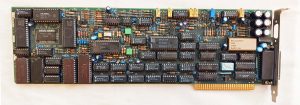
CDA Controller for IBM PC
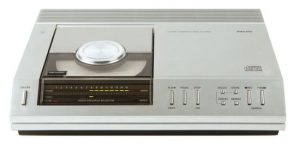
Philips CD100PC. I tapped into the error detection flags and the HF signal from the pickup and connected them to a connector on the CD100. I also designed and built an ISO bus card that fit in the IBM PC and decoded the various signals from the player.
We soon changed to a Philips CD950 player.
LaserVideo by now had changed their name to Disc Manufacturing, and had sold 100 or more CD Analyzers either directly, or through other third parties.
There were several variations of the CD Analyzer over the years: The first was a VideoDisk Analyzer, which substituted a VideoDisk player for the CD player. There was a clear disc analyzer that could play an unmetalized disc by substituting a more powerful laser. This enabled the manufacturer to test the discs before metallization.
LaserVideo by now had changed their name to Disc Manufacturing, and had sold 100 or more CD Analyzers either directly, or through other third parties.
Later on, I made a glass master player that worked the same way, but played a master made from 1″ thick glass!
As soon as I noticed that there was a demand for such a thing, I contemplated making it into a Clover Systems product.
QA-101 is born…
I decided to make a Clover Systems CD Analyzer, which I called QA-101. At last. I could have a real product, and a real business!
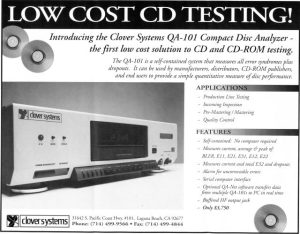 It was a self-contained unit, so the PC was optional. It originally used the Philips CD950, which I modified to add a window for an LCD, and a couple of buttons to control the software. I designed and built a circuit board that could fit inside the player and decode the signals from the pickup. It had a serial communication interface and MSDOS software so it could send the test results to a PC, where they could be displayed and printed.
After a while, Philips stopped making the CD950 player, so I had to make my own. I was able to buy the optical pickups and servos from Phillips, and I designed and built a PCB that decoded the error signals, and could fit inside the player, along with a vacuum fluorescent display. It had an RS-485 serial interface and QA-Net software that could connect to 32 QA-101s to one PC.
Eliminating the PC made it very inexpensive, and opened up a whole new market for CD testing. Now anyone in the supply chain from manufacturer to end user can accurately evaluate disc quality.
QA-201
The QA-201 Added a Time Interval Analyzer in the form of an IBM plug in card, and software to control it. This allowed the QA-201 to measure the exact length of all pits and lands on the disc, displayed as a histogram. This is important because the information on a CD is encoded in the length of the pits.
CDX
The next step was the advent of high-speed CD drives designed to read CD-ROMs. These drives were configured to be installed in a PC, and could read CDs at up to 40X speed. The original CDs were designed strictly for music. But the world soon discovered that CDs are ideal for any kind of data storage, and the faster the throughput, the better.
Since they required a PC to take advantage, the CD drives took the form factor of a floppy disk drive.
Higher speed was obviously an advantage for anyone testing discs; this resulted in the creation of CDX.
CDX was based on a Plextor CD drive, and required a PC to control it.
This also meant we could use off-the-shelf CD-ROM drives for our Analyzer without having to make a chassis, displays, etc., as everyone already had an IBM PC clone.
Thanks to the evolution of FPGAs (Field Programmable Gate Arrays), I was able to make a small PCB that decoded the error flags, attached to the back of the CD-ROM drive, and had a serial interface to the PC, so nothing had to be added to the PC.
CDX software could then perform all kinds of display and analysis.
DVX
Eventually, DVD discs came to dominate the market. DVX was configured just like the CDX, and could be purchased with or without the PC.
It could test CDs at up to 48X speed, and DVDs up to 16X. DVX could test all formats of CDs as well, so pretty much replaced the CDX.
AMM-1
An important part of measuring disc quality is pit geometry. The ability of the player to read the disc depends on the geometry of the pits on the disc: length, width, slope of the walls, etc.
The AMM-1 Analog Measurement Module added the capability to make pit geometry measurements on CDs and DVDs. All of our disc analyzers have the capability to make these measurements using an oscilloscope, but the AMM-1 automates this procedure and does not require an oscilloscope.
Data Recovery Player
This was a special player that could test “unplayable” discs, and recover data from the disc. I think we sold a couple to the CIA, but that’s about it. It required modifying the player’s firmware .
ISRCView Software
This was a stand-alone software that could display the ISRC codes on a CD or DVD. It was useful for content producers to check that the ISRC was properly encoded into the disc, and sold for $10. It is now available for free.
Laser Beam Recorder
The Laser Beam Recorder was quite a project.
Optical discs are mastered the same way as the old-fashioned record lathe, but way more complex.
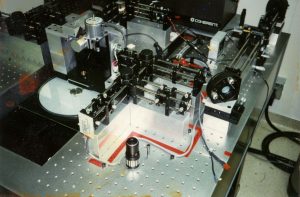 Laser Beam Recorder
The master is a glass disc 12" x 1", manufactured ultra smooth. It is a photographic process, where the disc is coated with photoresist and then exposed by a laser beam while rotating.
The parts of the disc surface that were exposed by the laser, can now be washed off by a chemical bath, similar to developing a photograph. The disc is now immersed in a chemical bath that will dissolve the glass where not covered by photoresist. The timing determined the depth of the resulting pits.
Because the pits are micron-sized, the process requires extreme precision. An electron microscope is required to see the pits.
Glass Master Player
The Glass Master Player is used to test the finished master disc. It works just like an ordinary CD player, but with a heavy glass disc. This requires a stronger motor, air bearings.
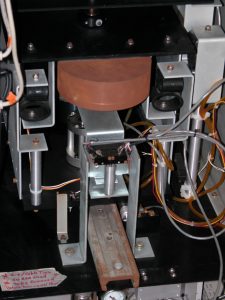
Glass Mater Player
======================
The great recession
The CD/DVD business peaked in 2000, and began a long slide to oblivion. By 2010, there was very little demand for disc manufacturing equipment. ruined many businesses, and I was forced to sell our building and move home.
By 2010, there was virtually no market for our products. This happened at the same time as the "Great Recession" of 2008-2020, so my business was ruined. We had to sell our building and move to home, where I still built some CDXs and DVXs for a while. Luckily, the Dynamo Regulator and SunBook could both be made in my spare bedroom.
SunBook 2011 - 2013
I had always wanted to have a daylight-readable laptop PC so I could lounge on the beach while working. If you've ever tried this, you know that it doesn't work; the screen is completely black! I was aware of transflective LCD displays that could be used outdoors, but they used so much power that a laptop battery would be drained in a few minutes!
But I happened to come across a Silicon Valley outfit that invented a transflective LCD that didn't require a backlight, so I started making daylight readable netbooks in my bedroom.
(see sidebar)
Dynamo Regulator 2013 - 2018
After just a few years, Pixel Qi was unable to supply LCDs, and I had to come up with another product.
I had perceived from my own personal experience that I would like to replace my XKE's voltage regulator with an electronic one, so I developed an electronic voltage and current regulator for DC generators.
It turned out that there was a market for this, so I started manufacturing Dynamo Regularos in my bedroom.
It was fun, as I met many interesting car people and their collections. In the late '60s, auto manufacturers switched to AC alternators, so my customers were pre-1970 classics, as well as tractors, buses, airplanes, boats, motorcycles, and even diesel locomotives! I'm glad I was able to help keep antique and classic vehicles on the road.
This actually turned into a pretty good business. Turns out there are a lot of people with antique cars/trucks/motorcycles/airplanes, etc. There was a couple other tranisterized voltage regulators on the market, but the Clover product was more versatile and higher power.
They were fairlly easy and cheap to make.
Failed Products
Even as a teenager, I wanted to make music related products. While working with Leon at Skyhill, I developed a few products that were flops.
Field-Sequential Video
Phase Shifter
At that time, the "phase shift" or "flanging" effect was something new and exciting. The first phased shift box was made by Carl Countryman, and was quite successful.
It was actually quite a simple device, so I thought, "I can do that too". I etched circuit boards in the bathroom sink, and packaged them in an off-the-shelf box.
Phase Shifter
It was pretty crude, but it worked. I sold a couple, but I really didn't have any idea how to market it.
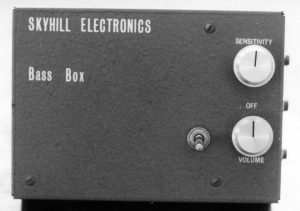
Bass Box
Bass Box
This was an accessory for bass guitar. The output of the guitar triggered a percussive sound generator that
Tape Speed Controller
 This was a variable speed motor controller that could vary the speed of AC synchronous motors, such as those used in tape recorders.
Pro Printer
This was an InkJet CD printer for very fast throughput.
Automated CD printers typically used a robot arm to load the disc into a tray. This was quite slow. My printer pushed the discs from the bottom of a stack of discs so it could load a disc in a fraction of a second. For people who need to print a lot of discs as fast as possible, it was a big help.
ProPrinter
The QA-101 was a good example of how a mass produced consumer product could be repurposed for a new application, so I wanted to do the same with an inkjet printer.
I started with an off-the-shelf Canon inkjet printer, and devised a new disc feeder and case. The Canon electronics did not need to be modified. I was able to tap into the needed signals to drive the new disc feed mechanism.
It worked great and was lightning fast, but just as I was getting ready to make a new enclosure, Canon discontinued that model.
That was a disaster, as their new model was very different, and could not be adapted so easily. I decided that it was not worth the trouble to start over, and gave up.
Unfortunately, I spent a lot of time and money on that one...
=================
The End of the Road...
I quit updating the website in 2016. The peak of CD/DVD sales was 2000, and then it was downhill for the next 10 years.
Unfortunately, the Great Recession came along at the same time in 2008-2010. By 2010, our business had gone to zero. All of our neighbors were bailing as fast as they could. For those of you who weren't there, it was really miserable. People were losing their homes and their life savings. My wife and I lost half of our life savings in that fiasco.
Enterprise Court
In 2004, we bought a lovely new facility in Lake Forest, CA. It was brand new, and had a really nice nature park attached. Had room to work on the cars, too!
By the end of 2010, we were forced to sell. The mortgage, the CAM fees, were just too much when no-one needed CD/DVD test equipment.
Luckily, I was able to start making and selling SunBooks out of my bedroom.
At the same time, I also got the idea for the Dynamo Regulator. It's always a good idea to have a "Plan B".
By the end of 2013, Pixel Qi screens were no longer available for SunBooks, and I had only Dynamo Regulators to keep me alive. Fortunately, by 2016 I could start Social Security with full benefits.
Well, nothing lasts forever, but it was a wild ride! Now I drive to Laguna Beach (10 miles away), sit on a bench, stare at the ocean, and say to myself, "This is the payoff! I worked my butt off for 60 years, and now today is payday!"
Poor Yuriko broke her hip in 2020, and also became demented with Lewy Body Dimensia.
She passed away i Oct. 2023.
End of life story...
Text Link
YouTube Video Link: https://youtu.be/Iwccfu3EDSI
Discography:
https://www.allmusic.com/artist/gordon-rudd-mn0001253469
https://en.wikipedia.org/wiki/Holland_(album)
Table of Contents
TOP