
Electronic Dynamo Regulator
-------- Gallery of Customer's Cars
I've had my 1962 SI E-Type OTS for 50 years, and over the years, I've replaced a lot of distributor points and voltage regulators. Seemed like I was constantly filing, replacing, and adjusting the points, and constantly having charging problems.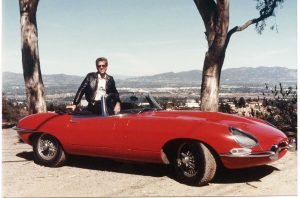
Although I had tried hard to keep the car all original, I finally got wise and installed a Pertronix breakerless ignition, which fits in the distributor and so appears as original. It turned out to be a huge improvement. No more filing, replacing, and adjusting the points, and the timing was rock solid.
This led me to think how the same could be done for my unreliable voltage regulator. Since I spent my life developing electronic products, I thought I'd give it a try. It took two years, because I used state-of-the-art technology, and high-reliability components, but it turned out so well that I thought this would be helpful for others.
Replacing the old mechanical regulator not only saves a lot of time & grief from filing relay contacts, adjusting voltage, current, & cut-out, but I discovered later that in some cases, if I took it to a shop to fix a charging problem, the shop had replaced both the regulator and the generator, when all that was wrong was the regulator. This has cost me a lot over the years.
Protect your investment with the latest state-of-the-art technology. Avoid an inconvenient dead battery, and get consistent performance.
How the Regulator Works
All generators work by rotating a loop of wire in a magnetic field. In a dynamo, the magnetic field is created by electromagnets (field coils). Voltage and current are controlled by controlling the current to the field coils. The current through the field coils determines the strength of the magnetic field that the armature rotates in, and thus the output of the generator.
In the Clover Regulator, the output voltage of the generator is compared to a precision voltage reference. When the generator output exceeds this reference, the current to the field coils is cut off. This causes the generator output to fall. When the output falls below the reference voltage, the field current is turned back on. In this way, the field current is modulated at a rate of 50 – 125 Hz. These rapid changes are smoothed out by the inductance of the field coils, thus maintaining a constant output voltage.
Current limiting is accomplished in the same way. Output current is sensed with a Hall-Effect device that detects the magnetic field created by the output current. When the output current exceeds a preset limit, the field current is turned off. Just as with the voltage regulation, the field current is modulated to maintain a constant output current.
Instead of a cut-out relay, we use a MOSFET “ideal diode”, which provides much higher efficiency than Schottky diodes. Power is supplied whenever the dynamo output voltage is greater than the battery voltage, rather than a pre-set voltage as in the mechanical regulator, and battery voltage is never fed back to the dynamo armature.
In the mechanical regulator oscillograph below, note that the field voltage spikes in the opposite direction when the relay contacts are opened. This is due to the stored energy in the field coils. This is similar to what happens in an ignition coil. Most regulators include a load resistor to try to minimize this effect. Also note the relay contact bounce when the relay closes.
In the DR340 Electronic Regulator, the “back-emf” is eliminated by a high-power diode. The result is much cleaner and more efficient switching with reduced radio interference.
Dynamo vs. Alternator
If performance is the only consideration, the alternator is the best choice. It delivers more power, has greater output at lower RPM, weighs less, and is cheaper.
But there are some good reasons to stick with your original dynamo: For one thing, if you don’t need a lot of additional power, there is no reason to go to the bother and expense of changing to an alternator. Furthermore, the conversion will require special mounting brackets and wiring changes.
There are some cases where conversion to alternator is not practical, for instance if your original dynamo is integrated with the steering pump or tachometer feed.
Finally, all-original cars are more valuable than modified cars. If you are a purist, you can keep the charging system completely original by modifying your existing regulator to all-electronic.
Shunt Wound vs. Series Wound
There is sometimes confusion about "series wound" and "shunt wound" dynamos. All dynamos use electromagnets (field coils) to generate the magnetic field. The field coils are energized by the output of the armature. In a "series wound" generator, the field coils are wired in series with the armature, so the full output of the generator passes through the field coils. As a result, a greater load increases the field current and therefore the generator's output. But in this configuration, no external control of the output is possible.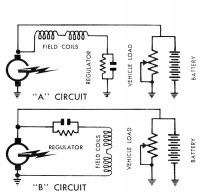
In a "shunt wound" generator, the field coils are wired in parallel with the armature. In this case, the field current can be externally controlled. Shunt wound dynamos come in two types: A-circuit and B-circuit. In the A-circuit dynamo, one side of the field coil is connected to the armature output, and the other end is connected externally (by the regulator) to ground. In the B-circuit dynamo, one end of the field coils is connected internally to ground, and the other end is externally connected (by the regulator) to the armature output. So, the A-circuit regulator shunts the field current to ground, and the B-circuit regulator supplies field current from the armature output.
Virtually all automotive generators are shunt wound. Autolite, Bosch and Delco (GM) generators are A-circuit. Ford and Lucas are B-circuit. Operation is identical except for the way that the field coils are connected. Autolite and Delco "Heavy Duty" generators are B-circuit, so it's important to know the type of generator we are dealing with.